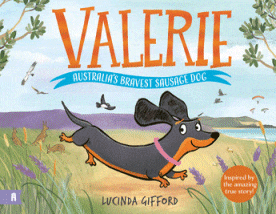
Valerie: Australia’s Bravest Sausage Dog

Valerie: Australia's Bravest Sausage Dog

Valerie: Australia’s Bravest Sausage Dog


Valerie: Australia’s Bravest Sausage Dog

Lucinda Gifford

Albert Street, 2026

32pp., hbk., RRP $A19.99

9781761182594

In November 2023, Valerie, a miniature dachshund, was with her  family at a campsite on Kangaroo Island SA, when the familiar smell of sausages sizzling drifted past her nose.  The humans were having a barbecue and she hadn’t been invited!!! Surely  that was an oversight.

So being a normal dog who likes a sausage, she followed the smell, stole a sausage off the grill and took off down the hill…starting a real-life adventure that lasted 579 days and made the news around the world. For, despite being microchipped and having an Apple AirTag,  Valerie managed to elude discovery in the wilderness for more than 18 months, somehow surviving until one day, a farmer saw a little dog running across his paddock, took a photo and…

Now, as well as having an episode of Australian Story dedicated to her, Valerie is the focus of this charming picture book as Lucinda Gifford has let her imagination run wild as she recounts the adventures Valerie might have had as she befriends dolphins, eats her fill, and explores the wilds before returning home safely.

Living the beach life and riding the swells.
Practising backstroke and digging up shells.
Dining on oysters and fancy ice cream…
Valerie knew she was living the dream.

Suddenly, Valerie heard urgent cries.
Hastily, Valerie grabbed a disguise.
‘What missing doggie? I don’t think that’s me…
I’m on an adventure with lots more to see!’

Told in rollicking rhyme in a series of vignettes, Gifford has created the most engaging, uplifting story that will delight readers of all ages and not just because of its happy ending,  Little ones can look at the delightful illustrations and tell themselves the story, building up the drama as a wave washes her off the boat that she took refuge on to eat her stolen sausage, and then follow on as her thefts were not restricted to that one escapade, while older readers will LOL at her adventures and perhaps relate to there really being no place like home.
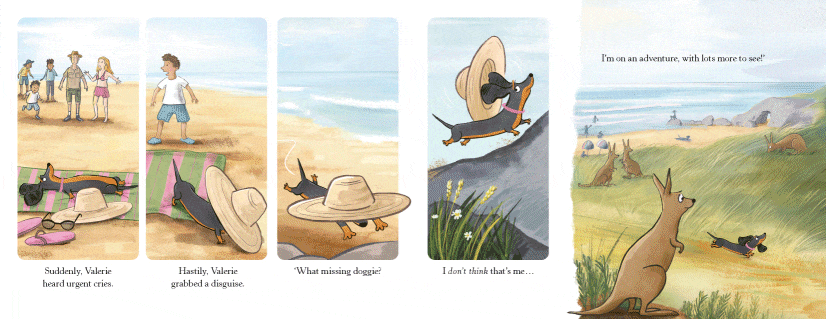
A peek inside...

A peek inside…

Just a joyful, fun read that tells a wonderful story to put a smile on the face… especially knowing that it is true -well bits of it!!! Who doesn’t love a bit of poetic licence and a happy ending?
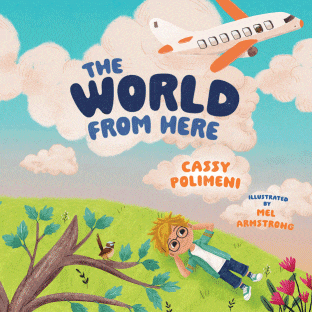
The World from Here

The World from Here

The World from Here


The World from Here

Cassy Polimeni

Mel Armstrong

CSIRO Publishing, 2026

32pp., hbk., RRP $A26.99

9781486319855

Have you ever stretched out on the grass on a warm day and looked for pictures in the clouds?

Perhaps you have flown above the clouds and looked down on land spread out like a giant quilt.

Or maybe you’ve had a fright as lightning flashes and thunder cracks overhead.

Or even, as I am now, watched the fog rolling in from the mountains cloaking everything in mist and blurring even the tallest, sturdiest trees into ghostly shapes.

Blending storytelling with science, readers experience the natural weather wonders of the planet through Milo’s ground-based perspective, and Maya’s airborne view from the window of the plane. Both wonder at the clouds, both feel anxious during the storm, and both marvel at what is revealed afterwards as Milo sees what emerges after the rain, while Maya has such clear skies she can clearly count the stars. 

A blend of nephrology, meteorology and geography, this is a fascinating book that takes the very abstract concept of perspective and places it into the real world so young readers can begin to understand that each person sees the world and its wonders differently depending on where we are, where we are from, what we know and believe and have experienced and even out frame of mind at the time.  By having Milo and Maya both looking at the same things but in physically different places, the reader can understand that what they see will be different – the tricky part is trying to imagine the view from the different angle.  At the same time, after the storm which makes each of them feel uncomfortable, both children are encouraged to look for the details in Nature.

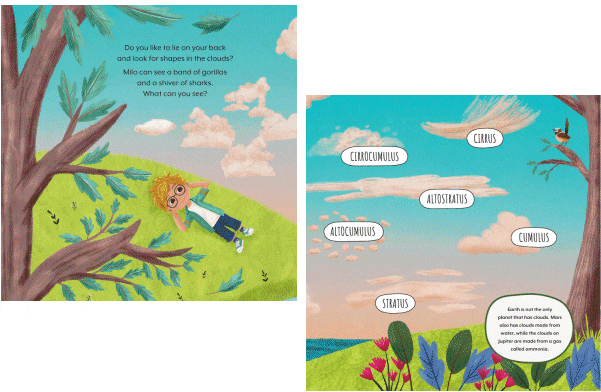
So is this a book about basic Earth Sciences, and the weather in particular, or is it an introduction to better understanding the people around us and learning to form better relationships? IMO, it is both.  While the storytelling text could be viewed through the lens of developing friendships  – the storm could be an analogy for a disagreement or argument and “things might look different after a storm, so pay attention” – the accompanying speech bubbles are designed to increase knowledge and understanding of the phenomenon – the study of clouds is called nephrology, and the  tendency to see shapes in them in pareidolia.  Connecting the two seamlessly are the vibrant illustrations  that expand the physical elements of the text, but also are so much more than scientific diagrams. 

A peek inside...

A peek inside…

Whether this is used as an introduction to weather (and back matter and teachers’ notes add to this aspect) or a way of helping students understand relationships better, perhaps even resolving conflicts, it is unique in its concept and  has a foot firmly in both perspectives. 


Blue: Dragon of the Sea

Blue: Dragon of the Sea

Blue: Dragon of the Sea


Blue: Dragon of the Sea

Aleesah Darlison

Tamlyn Teow

Wombat Books, 2026

32pp., hbk., RRP $A26.99

9781761112706

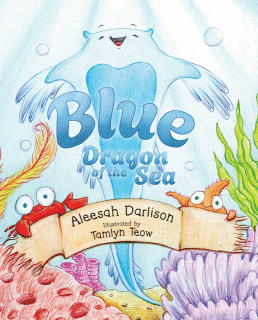
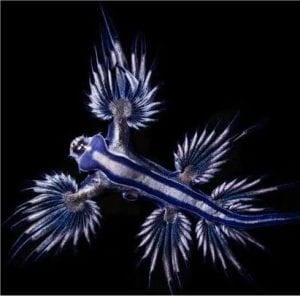
Despite its title, this is NOT the story of a winged, fire-breathing dragon who has fallen into the sea and found a home there. Rather it is the story of another of the almost-unknown creatures that live beneath the surface of the sea. With a name pronounced “nudi-brank” and meaning “naked gills”, nudibranchs are probably as far removed from those mythical flying creatures as you can get because they are commonly called sea slugs, come in all shapes, colours and sizes, and there are over 3000 different types. 

Blue, in particular, is a blue glaucus or Glaucus atlanticus and between Darlison’s lyrical text that flows just as Blue does, and Teow’s imaginative, colourful illustrations, young readers with a fascination for what’s under the waves can learn about these little creatures that don’t have brains but do have a special trick for keeping themselves safe.

But as well as being “tiny ballerinas of the sea”, with their rapid life cycles, are especially sensitive to changes in their environment, making them invaluable indicators of broader marine ecosystem shifts, particularly those induced by human activities and climate change and so there is a citizen science project for those with a deeper interest to become involved in, particularly those with access to the Great Southern reef from Kalbari in Western Australia, around southern Australia, to Caloundra in south-east Queensland.

If ever there were a need to maintain a robust non fiction print collection, particularly for younger readers, then this is the sort of book that is a role model.  How many adults have heard of these tiny little creatures, let alone children? (As a former scuba diver, I had but…) So when you don’t know what you don’t know, how do you know to look for them online?  Serendipitous discoveries of books like these with their intriguing covers and titles, enticing illustrations and accessible texts as young readers browse displays or the manageable collection of print resources (as opposed to a zillion unsorted websites)  can spark a thirst to know more and perhaps establish a dream for the future.  

Whether it’s punk turtles, endangered rainbow birds, bouncing woylies, captivating capybaras, or any of the other fascinating species that Darlison has woven stories around to encourage young readers to celebrate the natural world with her and to better understand the interdependence of the ecosystems and the threats they face,  each story offers something new to investigate as the often-unseen world is brought into focus.  And awareness is the first step in appreciation and ultimately, conservation. 

Mystery of the Missing Turtles

Mystery of the Missing Turtles

Mystery of the Missing Turtles


Mystery of the Missing Turtles

Deborah S. Bower, Ricky-John Spencer, Michael B. Thompson, James U. Van Dyke, Elizabeth Hale

James O’Hanlon

CSIRO Publishing, 2026

32pp., hbk., RRP $A26.99

9781486320288 

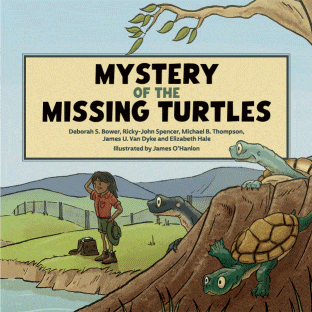
At the bottom of Brooke’s farm runs a creek, its waters and banks alive with wildlife that she loves to watch and write about in her notebook,   Her favourites were the freshwater turtles with their long necks, and yellow and black shells, the with flat heads and broad shells , and the Murray River turtles with a pale stripe along their face,  But she was puzzled – all the turtles she saw were big and old.  Where were the young turtles and the babies?  Time to investigate.

And what she discovered is a story that could happen along almost any riverbank, and what she did could also be done by any child (and their parent) who cares.

Written by the turtle biologists who created the 1 Million Turtles Citizen Science Project to encourage participation in turtle conservation in Australia, this is an engaging story that highlights the plight of yet another of our critical creatures and offers our children an opportunity to be leaders in their family and community in protecting them.  Australia has about 30 species of turtles, including the punk turtle of the Mary River, but they can be found all over the continent wherever there is water and wetlands. But like so many species, their habitat is threatened by human development and the spread of feral creatures like foxes and so Brooke’s story is one to inspire young readers to not only investigate what might be in their local rivers but understand what they can do to help.  

As well as the brief informative notes about turtles in the back matter, including the statement that “all tortoises are turtles but not all turtles are tortoises” (and an explanation why), there are also teachers’ notes to explore the turtles’ plight further – foxes aren’t the only threat – as well as the opportunity to become involved in a citizen science project to further their knowledge and understanding.

As with all CSIRO Publishing books for this age group, our younger students are introduced to something out of the everyday that could send them on a whole new path of discovery, awareness and action. 

Ruby’s Perfect Fire Safety Plan

Ruby’s Perfect Fire Safety Plan

Ruby’s Perfect Fire Safety Plan


Ruby’s Perfect Fire Safety Plan

Wendy Rudge

Tom Jellett

Wild Dog Books, 2026

32pp., hbk., RRP $A24.99

9781742037110

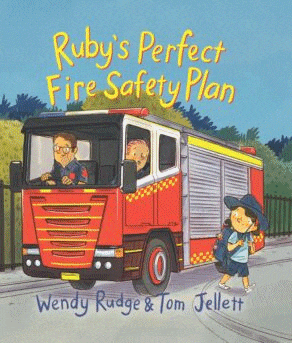
If Ruby were a Scout, she would certainly be the epitome of their motto, “Be prepared.” Ruby loves plans. She has a plan for the perfect sandwich,
the perfect sock drawer and the perfect birthday party. But, following a visit from the firefighters at the local fire station, she realises that her family don’t have a plan for keeping themselves safe in the event of a fire.

And so, based on what she has learned, she sets about creating one by identifying the fire risks in her home and the easiest ways to get out if they need to, creating a poster for calling 000, checking the smoke alarms, and practising fire drills.  Her family are impressed by her knowledge and how thorough she is, and participate, even taking responsibility for some of the things that need to be done.

At this time of the year particularly, bush fires are not far from people’s minds, but sadly, there is hardly a day that passes without a family losing their home to a house fire somewhere.  While we are often reminded to check the smoke alarms and know what we will do should there be a threat, often life gets in the way and those essentials are not done.  So sharing Ruby’s story written especially for younger readers, perhaps even organising a visit by the local brigade can be the impetus that a child needs to be the family’s leader in this critical task. Have them consolidate their learning by preparing a checklist of things to look for, preparing the poster, and practising the drill in the classroom and then encouraging them to make it the dinner table conversation.  Hopefully, parents and older siblings will take it as seriously as Ruby’s family did.

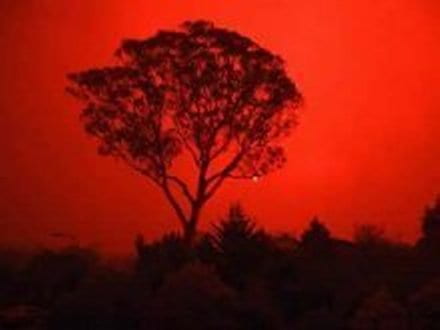
Having personally anxiously watched the skies as the fire dragon roared down from the hills surrounding Canberra in 2003, and then having had to evacuate our mountain home twice in the Black Summer of 2019-20, as well as the news of threats, evacuations and lost homes that is the backdrop to every Australian summer, no one is immune from the possibility and so that maxim of being prepared is critical. 

The fire dragon roars through Canberra suburbs, January18, 2003

The fire dragon roars through Canberra suburbs, January18, 2003

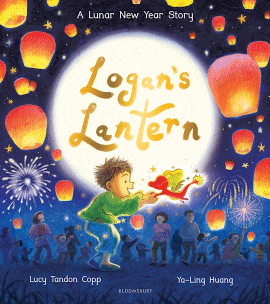
Logan’s Lantern

Logan's Lantern

Logan’s Lantern


Logan’s Lantern

Lucy Tandon Copp

Ya-Ling Huang

Bloomsbury, 2026

32pp., pbk., RRP $A16.99

9781526669506

In China, as the first new moon swells to its full glory, the festivities for the Lunar New Year are drawing to a close, and Yuan Xiao Jie – the Lantern Festival –  is imminent. Like his friends, Logan has made a lantern to be released into the night sky carrying a wish as the celebrations draw to a close.  Logan’s lantern is in the shape of a little dragon with golden wings, a paper tail and two black beans for eyes, and his mama carefully places a candle inside. 

As night falls the houses are lit up but as Logan steps outside. something squeezes his hand really tightly. It is his little dragon who confesses he is afraid of the dark… 

With fireworks rumbling overhead and vibrant lanterns glowing all around, can Logan muster all his courage to get himself and his little dragon to the festival? Is being brave about facing what’s scary – or is it about lighting the way for those we care about?

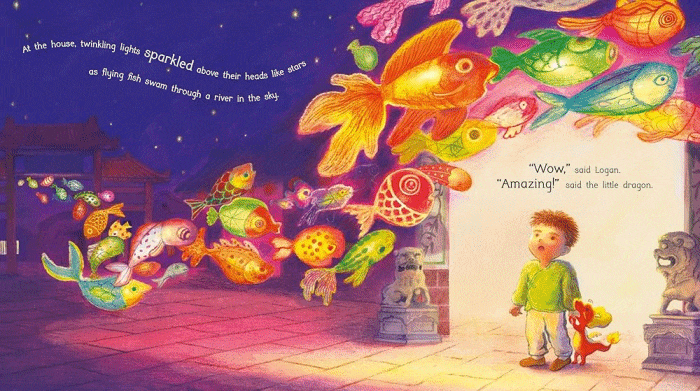
Set against the dramatic backdrop of the night sky, lit up by the lights and the fireworks as well as the vivid colours of the traditional flying fish and the children’s lanterns, this is a story that doesn’t just tell of Logan’s physical journey to the festival, but also his emotional one as step by step he ventures a little further and encouraging his dragon to do the same.  He forgets his own fears as he helps the little creature navigate his. So as well as learning about this end-of-celebration festival when often the focus is on its beginnings, young readers might also relate to Logan as he finds his way through the dark to the lights and the rewards to be found at the top of the hill as the moon shows its full face. Just as the moon rises and the sky gets a little lighter, so too does the dragon’s grip on Logan’s hand, so older readers might relate to the analogy of them overcoming what is holding them back, perhaps symbolised by the night sky of the illustrations, while being inexorably drawn forward to the reward/lights as they conquer their demons. 

A peek inside...

A peek inside…

This year, 2026, Lunar New Year falls on February 17th and it is the Year of the Fire Horse, while the Lantern Festival is Tuesday, March 3, 2026.  As well as acknowledging the heritage and beliefs of many of our students by sharing an engaging story, and working towards the outcomes of Intercultural Understanding, one of the General Capabilities of the Australian Curriculum, focusing on reflecting on culture and cultural diversity, engaging with cultural and linguistic diversity and navigating intercultural contexts,  there are so many opportunities to engage students in real-life learning across the curriculum as they investigate everything from the structure of the lunar calendar and other calendars commonly used to the traditional foods shared at the time to the beliefs, traditions, routines, rituals,  and symbols that underpin the annual festivities. A search of SCIS for “lunar new year” reveals many sources of information It was always one of the richest periods for teaching and learning during my in-school days.  

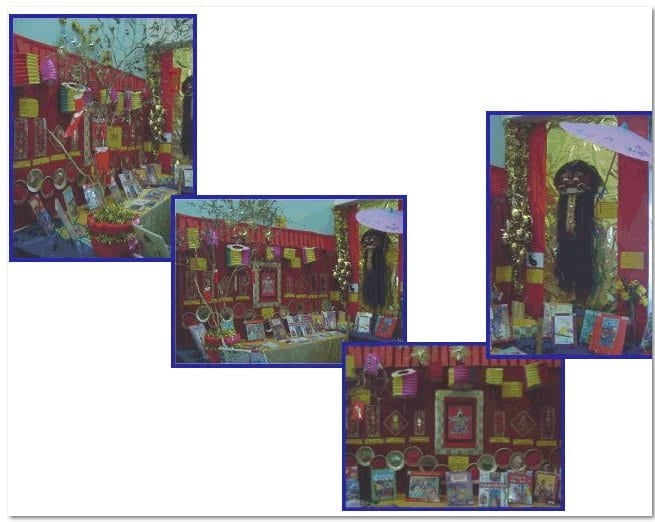
The opportunities for students to locate information and to use what they have learned to create and contribute to displays is endless. 

The opportunities for students to locate information and to use what they have learned to create and contribute to displays is endless.

Ramadan Kareem

Ramadan Kareem

Ramadan Kareem


Ramadan Kareem

M.O. Yuksel

Hatem Aly

Farshore, 2025

32pp., pbk., RRP$A17.99

9780008654603

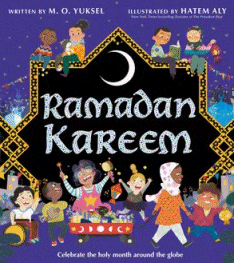
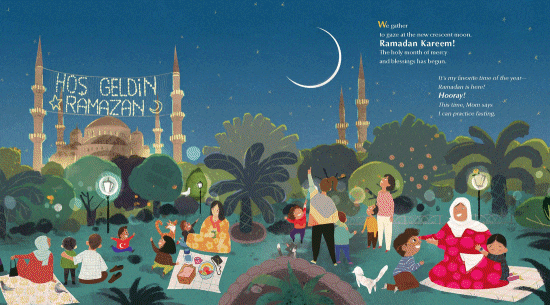
We gather to gaze at the new crescent moon. Ramadan Kareem! The holy month of mercy and blessings has begun.

As many of our students will observe  Ramadan, the Muslim festival considered as one of the five pillars of Islam, and revered as the month that Muhammed revealed the Qur’an,  from the evening of Monday, 16 February 2026 until Wednesday, 18 March 2026, this is an important book to have in the collection so that they can see their beliefs are acknowledged and accepted within the school community, as well as helping non-Muslim children understand the traditions and practices that underpin this important time for so many.

Vivid illustrations portray the anticipation and joy of the narrator’s excitement as she participates for the first time – as many-students will be doing- and readers learn of some of the special routines that families follow, the food they eat, the prayers they say and the other activities that are the focus of that first day, and the month that follows making it obvious that while self-denial is important, Ramadan is much more than that.  Brief notes and a glossary add more information.

A peek inisde...

A peek inisde…

Intercultural Understanding is one of the General Capabilities of the Australian Curriculum, focusing on reflecting on culture and cultural diversity, engaging with cultural and linguistic diversity and navigating intercultural contexts,  while the Personal and Social capability has outcomes explicitly supporting “students to recognise the emotions, abilities, needs and concerns of others [and to] develop their understanding about how respecting the perspectives, emotional states and needs of others is essential to social interactions”.   So this is an ideal book to develop those goals.

It might even be an opportunity for all to share their own religious beliefs, customs and traditions so that they can provide a foundation for investigation throughout the year as they occur. Given recent and continuing events, it would seem the need has never been greater.


What It Was Like to Be An Ancient Greek

What It Was Like to Be An Ancient Greek

What It Was Like to Be An Ancient Greek


What It Was Like to Be An Ancient Greek

David Long

Stefano Tambellini

HarperCollins GB, 2025

96pp., pbk., RRP $A16.99

9780008700546

Around 3,000 years ago, the ancient Greeks created one of the world’s most advanced civilisations. While most worked as farmers and fishermen to feed their families, others studied hard to become brilliant astronomers, navigators, philosophers, artists and athletes. Then, under the rule of Alexander the Great, their language, art and ideas spread through an enormous empire that stretched from Egypt to India.

As the Olympic torch wends its way through Italy and the  2026 Winter Olympics get under way, there is going to be a lot of interest in their origins, and the lives of those who were participants.  As well, from 2027 in New South Wales, the Human Society and its Environment K−6 Syllabus (2024) requires students in Stage 1 (years 1 and 2) to understand that “People use stories, images, objects and sites to understand the ancient past” with a specific focus on the ancient cultures of China, Egypt, Greece and Rome, and those in Stage 2 (Years 3 and 4) to focus on the ancient cultures of Mesoamerica which include  the Maya, Aztecs and Incas .  (Those in states and territories that follow the Australian Curriculum do not appear to travel this far back in time until Year 7.) 

Therefore, for those whose interest in these ancient cultures has been sparked, this is a useful introduction for young independent readers who want to know more about the time, the place and those who lived then and there.  Because of their scholarship, there is so much available already but this one, which begins with a map of the region at the time and has many other illustrations, features those topics that are most likely to interest  the age group including everyday life and the gap between rich and poor, male and female; the myths and legends of the gods atop Mount Olympus; their dedication to both sport and the arts; and their army as they not only fought amongst themselves but also the much larger Persian Empire’ and their eventual downfall as the Roman Empire emerged. 

Young readers will be fascinated to see how much this civilisation of so long ago continues to influence the modern world, and develop a richer understanding of those NSW syllabus outcomes. Others in the series that would also enhance those outcomes include What it was like to be a Viking; …an Ancient Roman, …an Ancient Maya, … an Ancient Egyptian, and …an Ancient Benin 

While the publishers imprint is HarperCollins GB, that is the parent company of the original publisher Barrington Stoke, whose mission is to break down the barriers to reading for those who find it tricky for whatever reason by using light-coloured paper which minimises glare, clear dyslexia-friendly fonts in less-complex sentences and short chapters, and other formatting and editing techniques to support emerging readers, so this book (and the series) would also be useful in a wide range of library collections.   

Let’s Make an Adventure

Let's Make an Adventure

Let’s Make an Adventure


Let’s Make an Adventure

Carrie Gallasch

Kia Hing Fay

Little Book Press, 2026

32pp., hbk., RRP $A24.99

9781923141216

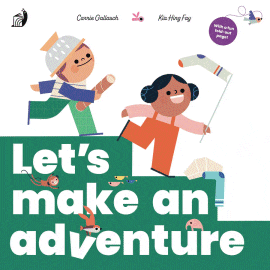
Is it possible to visit the country, the jungle, the ocean, the mountains, and go through tunnels all without leaving home or switching on a screen?  If you’re one of the children in the new book for our youngest readers you can!

For them, imagination goes well beyond the castle/cubby created with sheets draped over chairs, as a laundry basket becomes a boat, a suitcase becomes a horse and the backyard transforms into a magical mountain range as they visit different lands and meet the special creatures who live there. Who might you meet in the jungle or in the darkness of an underground tunnel?

As their older siblings are perhaps heading off to preschool or big school to have their own adventures, some of our little ones might be feeling lonely or left out, but this is an opportunity to share and show them how they can make their own adventures using their own imaginations and creativity because there is nothing like the ability of young children to shed reality and become immersed in the world of the imaginary.

This is almost a journey back in time for those of us whose childhoods were pre-screen days (even before television) when we were self-reliant for our entertainment and the tea wagon became a doll’s pram and a large cardboard box could be anything from a rocket to a submarine. It’s an opportunity for today’s child to let their imaginations wander as they become immersed in the rhyming and rhythmic text and vibrant illustrations, and build their knowledge and vocabulary as they meet the creatures who dwell in these faraway, unfamiliar places. So where might they go astride a suitcase?  Who might visit them in their curtain cubby? What battles against monsters might be fought as they wear their armour of a metal colander and wield a wooden stick? What else is hiding in plain sight to take them on a magical carpet ride?

A lively imagination and the ability to be divorced from the world around us are key foundations for being able to read and enjoy reading as an end in itself.  This book, that encourages our littlie to find their own fun inside their own minds is an excellent start! 

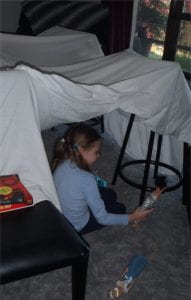
Some grandparents I know were treated to a full recap of "Frozen" including story and songsd as Miss 4 played in her cubby, oblivious to the audience.

Some grandparents I know were treated to a full recap of “Frozen” including story and songs as Miss 4 played in her cubby, oblivious to the audience.


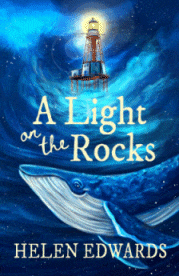
A Light on the Rocks

A Light on the Rocks

A Light on the Rocks


A Light on the Rocks

Helen Edwards

Riveted Press, 2026

274pp., pbk., RRP $A17.99

 9781764007191

In August 1859 in Adelaide, 14 year old Daisy boards the  SS Admella with her mother, father and younger sister Marigold and over 100 others on what should have been a three-day trip around Australia’s southern coastline to Melbourne.  Daisy has dreams of becoming a botanist, eventually travelling the country to draw and document the continent’s native flora, but if that is to happen, she has to overcome her uneasiness about this trip.  If she is to be an adventurer, then she must make the most of this adventure. On board she meets her father’s business partners, a long-time friend Jimmy who loves his new life at sea, and Henry, a young stable hand charged with looking after the six racehorses also making the journey to compete in  some of Melbourne’s rich horse races.

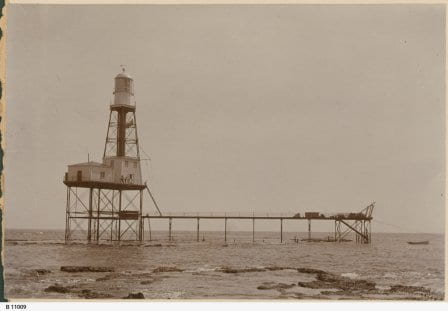
One hundred years later, in December 1959, Max and his older sister Rosemary begin their annual school holiday stay with their father on the Cape Jaffa lighthouse, as he begins his two-week shift tending the light which guarded the Margaret Brock Reef off the coast of Kingston, S. E.  Bullied at school because he can’t yet read and write as well as his peers. Max loves his time on the reef as he has dreams of being a great naturalist like his hero Gerald Durrell , making observations of the wildlife he discovers which Rosemary writes for him and he illustrates.

What connects the two families is an intriguing, captivating read for independent readers that draws on the true events of the voyage of the SS Admella which met its end after striking a submerged reef southwest of Mt Gambier and, with the loss of 89 lives, became  one of the worst maritime disasters in Australian history as well as the later construction of the Cape Jaffa Lighthouse manned by lighthouse keepers and their families until it was decommissioned a century later.  Staying true to the facts of both, Edwards has woven a narrative that, like On Gallant Wings, has been thoroughly researched while adding her own characters, the ghost of one of the horses that was on board, strange flickering lights and a pygmy blue whale named Moriarty whose song is threaded through the tale,  building  a story that switches between Daisy and Max that has the traits of hope and resilience at the forefront but doesn’t shy away from the original tragedy so readers need to be able to cope with the deaths of some of the characters.  (Author’s notes and readily-available research show the real figures, including that in reality, no children were saved and only one woman.) Interwoven with the courage of the characters is the wonder of a restless, incessant, unforgiving ocean that is not always the calm, gentle waves lapping on the shore that students might be used to, as well as the story of its inhabitants like Moriarty and the need to protect all its creatures.  And, if it is used as an engaging read-aloud in the classroom, it could also be teamed with a study of Robert Southey’s Inchcape Rock   as students start to develop an appreciation for the perilous journeys their ancestors took, the dangers they encountered and the courage they needed to begin what they saw as a new and better life -how bad must the old one have been to undertake such a mission? 

Once again, Edwards has crafted a masterful story that entertains and educates, introducing today’s students to the lives of children who have gone before in a way that will fill them with wonder., perhaps even have them seeking out other historical fiction. 

SS Admella, by Shaw, James (1815 - 1881), 1858 - oil on canvas; Courtesy of the Art Gallery of South Australia

SS Admella, by Shaw, James (1815 – 1881), 1858 – oil on canvas; Courtesy of the Art Gallery of South Australia

Cape Jaffa Lighthouse

Cape Jaffa Lighthouse