The Cherayroos: Underground Rules

The Cherayroos: Underground Rules

The Cherayroos: Underground Rules


The Cherayroos: Underground Rules

S. P. Doran

self-published. 2025

80pp., pbk., RRP $A28.59

9781764407007

Far away, hidden by an invisible force, lay a long-forgotten, secret, ancient forest called the Whisperdeep… Deep beneath the forest, the streets of CherayrooVille glowed soft green and amber from the roots of the Tree of Solace. Its big roost twisted through the underground village like magic veins, bathing everything in a warm, shimmering light… Beneath the giant Whisperroot tree, twisting tunnels led to this secret village nestled in the great tavern…

And in this underground world, in homes made of twigs, tree vines and leaves, lived small ancient creatures with saucer-like eyes twig-like arms and legs, and brown and green fluffy hair as they blended into their surroundings.  Small, but not shy, they were smart and creative, using the treasures of the forest to make toys and treats.  They even had their own language, as they spoke to each other in trumpets, puffs, whistles and chirps.

Cherayroo life was governed by the Rootscript of Rules and the most important was that only the Chief and his brave friends could leave the village – which was fine because the villagers preferred to stay home.  Except for one.  Chie did not want to stay home and he did not want to be the baker that seemed to be his destiny.  Chie is “part-explorer, part inventor and full -time rule-bender” who dreams of exploring the Above and becoming a warrior.  And then he discovers a map and he decides that this is his chance…
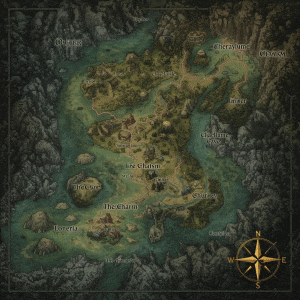
 

In this richly illustrated fantasy for young, emerging readers, the author has created a whole new world of landscapes and characters to appeal to those who like Chie, want to push the boundaries and go a bit further than they should.  They join Chie on his adventures as he explores meeting some strange creatures on his travels – not all of whom are as friendly as he would like – and while he is brave and resilient, he learns some important lessons – as does the reader who sees themselves in Chie, wanting to explore and discover and oblivious to the possible consequences.

Formatted and illustrated as a picture book, it is written in short chapters bridging the divide between picture book and novel, as well as including information about the Cherayvoos language, some of the Rootscript Rules, a quiz and some questions for readers to ponder.  There is also a website and a YT channel to add extra dimension and one suspects, there will be more adventures in the future.

There is much in this for both the younger and older reader, as they consider all the factors and challenges that would need to be addressed to build a whole, new world like this so that readers are immersed in the surroundings, and the characters’ personalities and stories as reality slips away. There is so much more to an engaging story than words and pictures. A worthwhile investment particularly if there is a story-writers group in the school or a budding novelist in the family. Perhaps start by sharing the description of a Cherayroo without sharing the illustration, and have the students interpret the words into a picture – and then discuss why each interpretation is different. And for those not yet ready to create their own whole new world, perhaps they could imagine where Chie’s next adventure might take him…
Bun

Bun

Bun


Bun

Hana Kinoshita Thomson

A &  U Children’s, 2026

24pp., hbk., RRP $A19.99

9781761182396

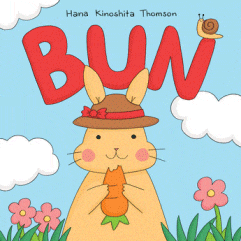
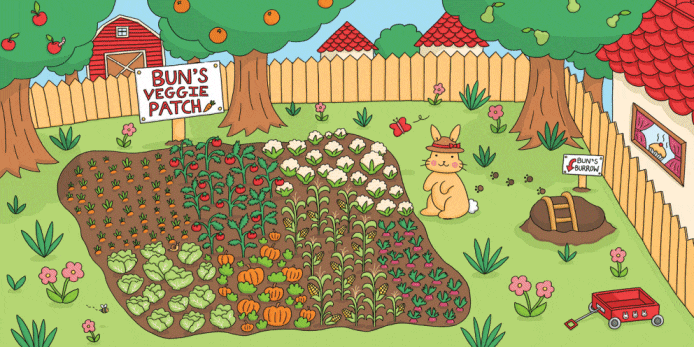
Bun is a bunny who loves gardening, baking and visiting her friends. And today is a special day because Daisy, Buttercup and Walnut are coming for afternoon tea, so there is much to be done before they get here.

Our youngest readers are going to love this story because of its simplicity as they follow Bun through the task of baking a special carrot cake for her friends, from gathering the carrots from her own vegetable patch, through to getting the other ingredients she needs from to grocer, to actually baking the cake and sharing it with her friends.  The text is a simple narrative but therein lies its beauty because the reader is encouraged to use the pictures to fill in the gaps.  How does Bun’s day start like theirs? What does she grow in her garden? What vegetables do they recognise? What’s your favourite? If she likes baking, what might she be going to pick? What might she be going to make? If you were going to have friends over for afternoon tea, who would you invite?  What would you make them? The astute adult will ask those sorts of questions throughout, so that the child not only engages more deeply with the story, but learns that by searching the pictures they can tell themselves the story – another critical step in those early reading behaviours to encourage.  They might even use the carrot cake recipe to bake together…

This one is definitely at the top of the pile to share with the preschoolers this term…

A peek inside...

A peek inside…


Saving Shark Pup

Saving Shark Pup

Saving Shark Pup


Saving Shark Pup

Sharon Dalgleish

Amandine Thomas

A & U Children’s, 2026

32pp., hbk., RRP $A24.99

9781761182013

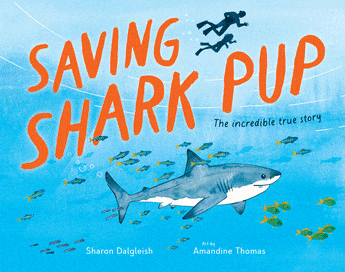
Sometime, somewhere in the depths of the ocean, a great white shark gives birth to a baby. Unlike some species that lay leathery eggs, this baby is fully formed and independent from the moment it is born, and mother and baby swim off in opposite directions.  Instinctively, the baby shark knows how to swim and explore the ocean to feed itself – until the day it is caught by the surf and is powerless against the pounding waves…

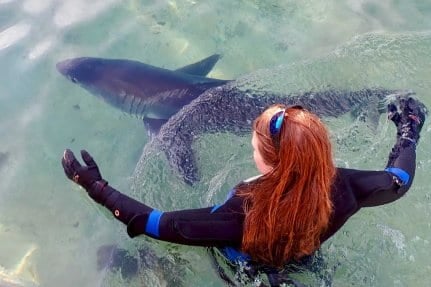
This is the true story of that baby shark that was found on Manly Beach, near Sydney, in September 2017 and the repeated attempts to rescue it and keep it alive so it could be returned to the ocean.  At first, the rescuers tried to drag Fluffy out to deeper water, but the incessant surf returns him to the beach and so more thinking and expert advice is required…

One of the divers who stayed with Fluffy in the pool overnight at Manly Sea Life Sanctuary

One of the divers who stayed with Fluffy in the pool overnight at Manly Sea Life Sanctuary

Telling the story in the present tense almost as an observer of the events as they happened, Dalgleish has captured the events of those two days so that the young reader is enthralled and needs to know if Fluffy makes it safely back to his ocean home, accompanying the story with snippets of information such as sharks going into a trance-like state and becomes disoriented if they are turned upside-down which may explain why this one kept returning to the beach.  

Given the recent spate of shark attacks along Sydney’s beaches this summer, including one at Manly, this is a topical and timely release that could be an integral part of a focus on beach and shark safety as we try to educate young swimmers about shark behaviour and when it is best to stay out of the water. How do we keep ourselves safe when we swim at the beach? Why would people go to such lengths to rescue a shark pup?  Should species, like the great white shark, be protected in Australian waters? What does “protected” mean? 

But as well as investigating the facts about sharks, their habits and habitats, it is also an opportunity to explore the human aspect as once again, emotions surface as there are calls for culling of sharks, the installation of shark nets and research into how both sharks and humans can inhabit the same space together.  Students could investigate if shark nets effective or if there are better ways to detect the presence and potential danger using technology, setting the groundwork for a formal debate with all the literacy learning that that entails.

Because the marine experts decided not to cause Fluffy any further trauma by tagging him, the reader cannot follow the rest of his adventures once he is eventually released, and so it would seem his known story ends with the final pages of the book. However, older students might like to investigate how what starts as a fleeting human interest story becomes the kernel for building something as engaging as this.  How has the author taken an incident that was fleeting and localised news at the time and built such an appealing story?  Working backwards, what questions might she have asked? What research might she have done?  How has she blended fact and fiction? What is the difference between writing a news article and a story for young readers? And those who prefer to illustrate than write could ask the same questions about Amandine Thomas’s illustrations.  What did she need to know and do to bring Fluffy to life in a way that he is no longer an anonymous shark, particularly as illustrators usually get the manuscript after the words are written? What techniques, colours and media did she use to make the story so realistic?  Such speculations deepen students’ understandings about story-crafting so they improve their own and this is the perfect example of how connections are made.

For me, the best storybooks are those that lead readers (and reviewers) down rabbit-holes by being entertaining as well as educational – and this is certainly one of those.


See Inside Famous Cities

See Inside Famous Cities

See Inside Famous Cities


See Inside Famous Cities

Matthew Oldham & Tom Mumbray

David Hancock & Alessandra Micheletti

Usborne. 2025

16pp., board book., RRP $A19.99

9781409599180

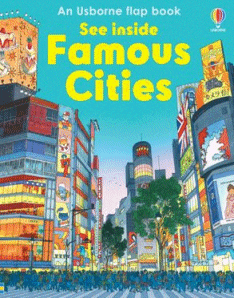
As school holidays draw to a close, many students will have visited some of the famous cities featured in this book and may well enjoy revisiting some of the sites and sights they saw, and perhaps sharing some of their adventures.  Others may be intrigued by what they discover under the flaps and decide that this is a place they want to visit in the future.

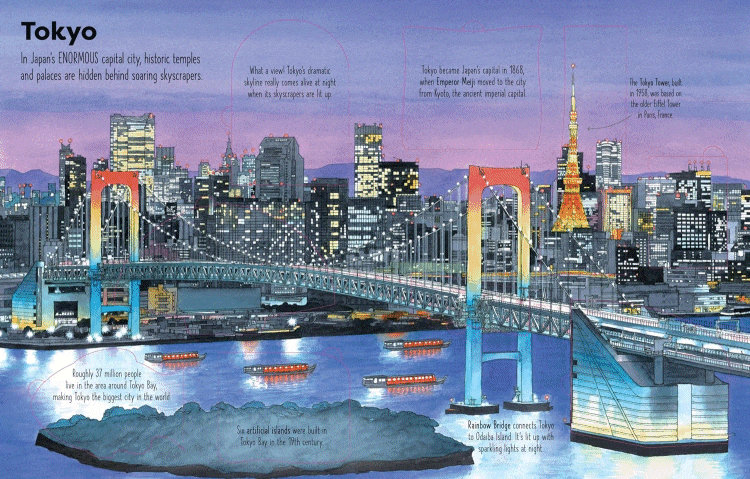
Whether it’s the bustling streets of Tokyo,  scenic Rio de Janeiro, or the ancient ruins of Rome, there is much to explore as they lift the flaps and learn about the history of legendary landmarks, glimpse stunning scenery and skylines, and see inside iconic museums and galleries.  Being a British publication, London is not featured and the only Australian representative is a paragraph on the final page about Melbourne hosting the “nation’s biggest sporting events.”

But that omission offers the opportunity for students to work together to create a page about their state or territory’s capital city prompting not only collaboration to decide on the six must-see places a tourist should visit but also research, writing and illustrating as they build the page.  It could also spark the creation of a page about their home town and its surrounds, helping them see it through a new lens as well as learning about its history, particularly if the focus is on places that are unique and they explore its natural, built and heritage features. They might even create an illustrated map of the must-sees and must-dos, and create an itinerary for visitors to use that could be offered to the local Visitors’ Centre.   Information literacy with a real purpose!

A peek inside...

A peek inside…


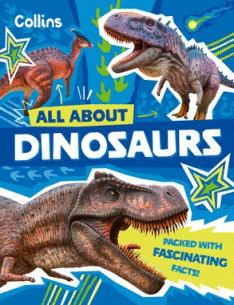
All About Dinosaurs

All About Dinosaurs

All About Dinosaurs


All About Dinosaurs

Discover fascinating facts about prehistoric creatures

Collins Kids

Collins GB., 2026

96pp., pbk., RRP $A19.99

9780008737528

If there is one thing every teacher librarian knows about collection development, it is that you cannot have too many items in your 567.9 section – that’s the section where you will find little and a-bit-bigger ones, gathered as they pore over the stories and information of those fascinating creatures that ruled this planet until 65 000 000 ago. 

So this new release, another in the All About… series, will be a welcome addition as it is written especially for those who are almost independent readers but still need lots of illustrations and accessible text in bite-size bits.

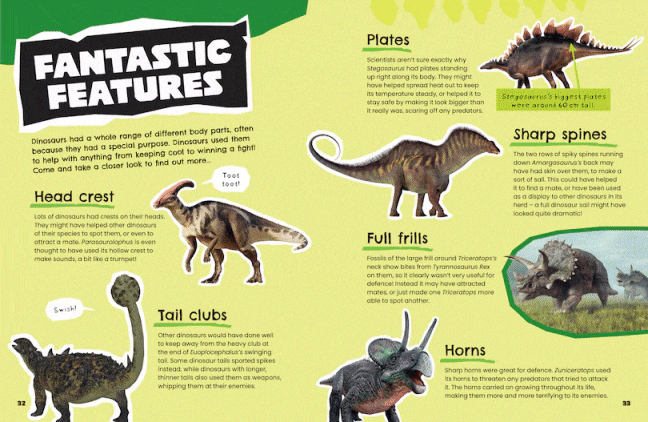
A peek inside...

A peek inside…

Beginning with a general overview, it then focuses on the different groups including heterodontosaurids, Thyreophorans, ceratopsians as well as the more familiar stegosaurs, sauropods and tyrannosaurs.  While the information provides an overview, those who want to know more could delve into the meaning of the names, how those names describe the key features of the group and perhaps even learn some Greek and Latin in their discoveries.  A pronunciation guide is included as well as a glossary and index so students’ information literacy is well supported.  Quizzes and Name that Dinosaur add to the interactivity.

While there may be many books about dinosaurs available already, there is always something new in a new release to attract the young reader, and there are always new young readers who are fascinated by them. 

Still Sal

Still Sal

Still Sal


Still Sal

Kevin Henkes

HarperCollins US, 2026

256pp., pbk., RRP $A19.99

9780063389632

The first day of first grade is just around the corner and Sal is very excited.  She believes school doesn’t really start until you reach first grade – kindergarten is just a warm up.  She’s excited about being in the same class with her friend Griff, using her special horde of school supplies of glittery pencils, cupcake erasers and books with animals on the covers, and all the other things that being a first=grader brings.

But things start to sour when her friend Griff receives a letter to tell him he will be in 1A with Ms Flowers, and Sal’s letter says she will be in 1B with Ms McCormick. Sal automatically forms a picture of Ms Flowers because of her name, which is reinforced when she sees the 1A students being handed name tags to wear while she has to search for her name on a desk – and it’s wrong!  She is Sal, not Sally.  And from there, things go from bad to worse…

This is a thoroughly readable book that would be an ideal read-aloud either at the beginning of term or a little later as we get children to “remember when…” to show them how much they have grown and changed physically, mentally and emotionally since those very first days.  Sometimes, when things don’t come as easily as anticipated and the negative voices start to creep in, reflecting on “I couldn’t then… but I can now” helps the child realise just how much they have achieved, whether it’s learning to manage at school or, like Sal, share a bedroom with a younger sibling, having her long, tangly hair cut, and worst of all, see Griff start to make other friends. Sal, herself, feels there is so much change in her life that she is “not Sal anymore.” 

In the past, I have reviewed a number of picture books by Kevin Henkes, including Wemberly Worried,  which also has a starting-school theme, and this is a stand-alone in the Miller Family series which explores and reflects those everyday issues that all families experience but done with the craftmanship of Henkes’ storytelling. 

It’s feel-good story about  family, friendship, social and emotional growth, resilience, and adapting to change that kept me reading and which will help all Sals in our care understand that despite all the changes, they are “still Sal.”  


Crocodiles Up Close

Crocodiles Up Close

Crocodiles Up Close


Crocodiles Up Close

Lisa McLellan

Wild Dog, 2026

32pp., hbk., RRP $A24.99

9781742037073

In the northern regions of Australia, protected by federal and state laws,  two of the planet’s most feared species prowl both the fresh and salty waterways. , feared by many but a critical part of the ecosystem.

Crocodilians have existed on Earth for more than 200 million years, sharing the planet with the dinosaurs. and while many species are now extinct, 28 living species still remain, including both the freshwater and saltwater crocodiles that are the main focus of this book for emerging naturalists with an interest in these creatures.

Illustrated with many photographs that enable the reader to see and understand the information in the accompanying text, and written for the younger independent reader, it begins with some general information about crocodilians and then hones in on the habitats and habits of those unique to Australia, offering fascinating insights such as the temperature of the nest determining whether the eggs will emerge as male or female young, and that only  one in a hundred of those hatchlings makes it to adulthood.

There is a glossary inviting students to explore and develop their vocabulary, perhaps ponder why “crocodilian” rather than “crocodile”; explore the difference between “reptile” and “amphibian”  or even venture into the Animal Kingdom taxonomic structure and learn the hierarchy of that.

As well as those sorts of facts and figures, teachers notes offer other areas to explore, while the book itself touches on the role that the creature plays in the culture and lives  of First Nations peoples both here and in Papua New Guinea, opening up the possibility for further exploration of that.

As well as identifying the relevant Australian Curriculum outcomes, there are also links to online resources such as this one, offering a more complete resource for those who see themselves as the next Steve Irwin…

A worthy addition to this fascinating series that helps young readers make sense of the world around them. 


No! I Can’t … Yet

No! I Can't ... Yet

No! I Can’t … Yet


No! I Can’t … Yet

Eva Rivelli & Lisa Fisicchia

Kayla Lee

Little Steps, 2025

32pp., pbk., RRP $A16.99

 9781923306158

Whenever Liva started something new and found that it challenged her or didn’t meet her expectations of success immediately, she gave up. It didn’t matter whether it was painting a picture or playing a sport, if she didn’t nail it straight away, she told herself she was not good enough and it was all too hard.  It wasn’t long before the negative self-talk embedded itself and she stopped trying altogether.  Until the day she saw a butterfly emerging from its chrysalis…

As the new school year approaches, there are going to be many who need to hear Liva’s story and her message – and not just those very little ones who expect that now they are at big school, they will learn to read on the very first day.  There will be many who find the jump in academic expectations challenging, especially those for whom previous years have been “easy”, and who need assurance that  things need to ne new and demanding so they can learn and grow.  There is no expectation that they will master testing situations straight away and that big journeys start with little steps, mostly forward, but there will be some that go backwards or even on another path altogether!

Accompanied by notes to parents and carers (and teachers), this is a book about being willing to persist and persevere, developing resilience and a positive mindset.  Indeed, if we go back to Cambourne’s Conditions of Learning – he said for learning literacy but they apply to everything, IMO –  the fourth is expectation.

Expectation—Set realistic expectations for language and literacy development. Become familiar with the developmental stages of emergent literacy, and support children in appropriate tasks. Expect that they will become accomplished readers and writers in their own time.”.

Not only should the adults in the child’s life show that they expect their children to master things in their own time, but the child needs to do so too.  

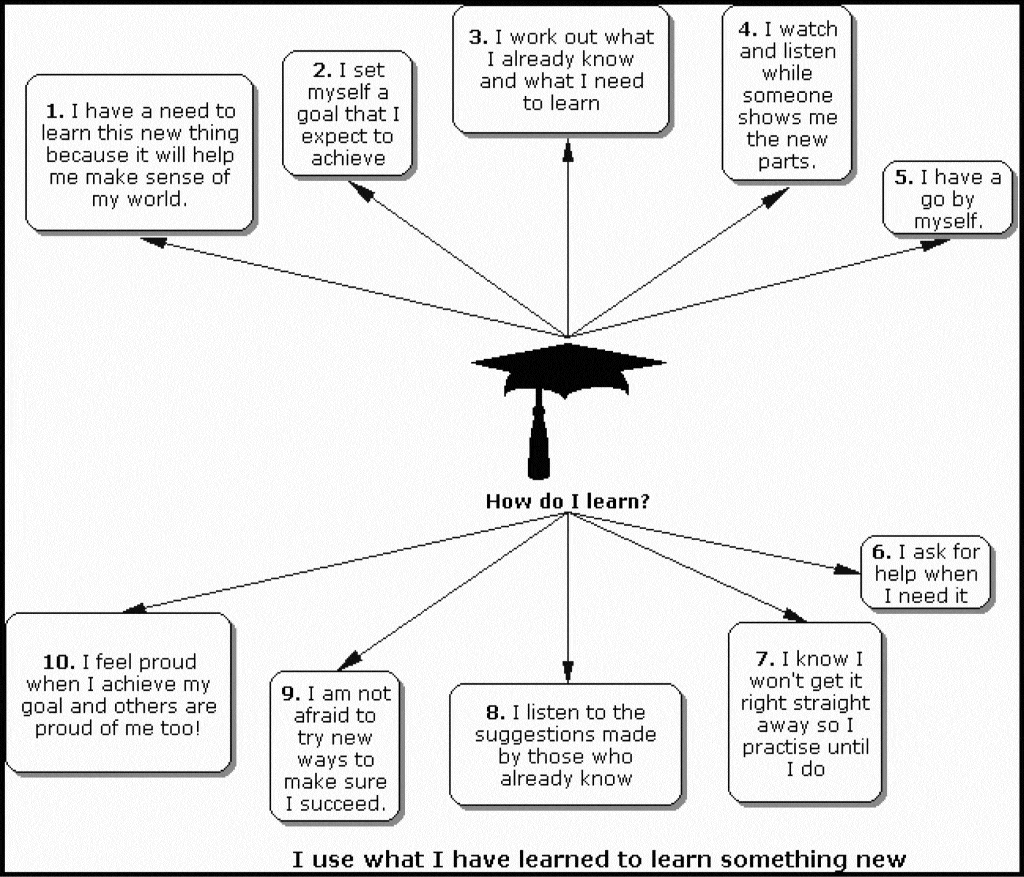
Thus this book could be an important introduction to help students begin to create their own philosophy and mantra about learning, perhaps a visual model that they can refer to when needed, along with Liva’s song .

“Don’t go crying, Keep on trying
Practice makes progress,
Practice makes progress. 
I’ve got this.”

Based on Cambourne's Conditions of Learning

Based on Cambourne’s Conditions of Learning

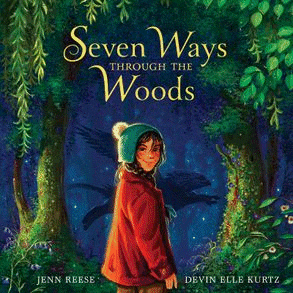
Seven Ways Through the Woods

Seven Ways Through the Woods

Seven Ways Through the Woods


Seven Ways Through the Woods

Jenn Reese

Devin Elle Kurtz

HarperCollins US, 2026

40pp., hbk., RRP $A24.99

9780063356269

There will come a time, not too far off, when you will stand before a deep , dark forest.

There are several ways through it, but which one will you take?  

Will you take the path most often trodden, following in the footprints of those who have gone before, a pretty walk but somewhat boring?

Or will you let your curiosity explore one of the other ways, where you might encounter griffins, giants, serpents, sprites, and more – each with its own special way to speed you, slow you, maybe even lead you off the path and away from your intended destination altogether? Perhaps you might even take the path that keeps you in the woods, rather than going through it, so you discover all the wonders that exist within it.  “Do not go through the woods at all. Stray off the path.” 

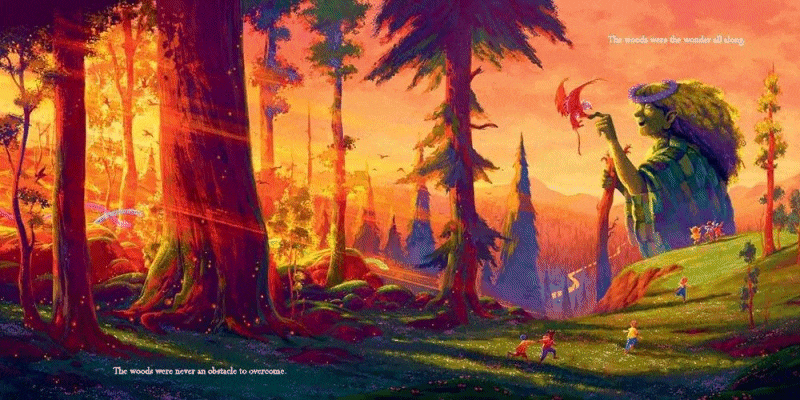
As the narrator speaks directly to the child reader, each one different depending on the path they choose, they travel through a forest that might appear dark, perhaps malevolent, but which reveals itself to be a place of enchantment and wonder through the captivating illustrations full of mood and magic as one soars on the back of a griffin and another is covered in the magic pollen of a portal flower.

A peek inside...

A peek inside…

Young readers will enjoy taking all the ways through the woods and then, having seen the choices, deciding which one they would take if they were one of the adventurers.  Older readers may view it as an analogy for the moral, ethical or social dilemmas that they may encounter as their horizons expand and their choices start to have consequences that are not the black and white solutions they are used to,  Indeed, they are more like fifty shades of grey!  It is an introduction to really considering cause and effect… If I do this, then this may happen but what might be the broader impact or implication of that?  Or they might begin to consider whether they really have to go through the woods at all… What might happen if they choose to stay where they are, go around the woods, or venture in and stay awhile?  Perhaps there is a different route altogether?  For those older readers, it’s an arm’s length way of becoming aware of life’s choices, that there is always an alternative if the obvious or peer-pressured one doesn’t sit well, including doing nothing or looking for a compromise, and the direction they take is in their hands. 


All About the World

All About the World

All About the World


All About the World

Discover fascinating facts about planet Earth

Collins Kids

Collins GB., 2025

96pp., pbk., RRP $A19.99

9780008737566

As our younger students enter a new class and a new phase of their education which opens their eyes and minds to so many new things, they are going to have more and more questions about this planet that they want answered.  So this new release which spans a host of topics spanning places, people, geology, geography, habitats and more is going to be the ideal addition to both the home and school library.

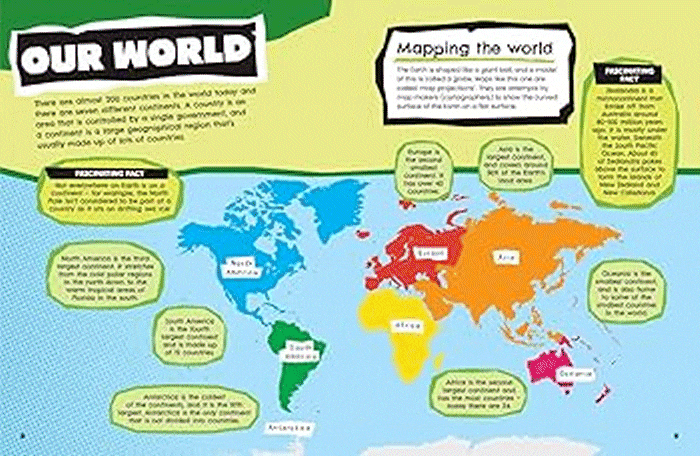
With hundreds of photographs and diagrams, facts that are brief, to the point and in accessible language, and a format that is not only visually appealing but allows the reader to feel capable of reading and understanding the information, they will find themselves dipping and delving into this book throughout the year, perhaps even being tempted to investigate topics that capture their interest even further. There are even quizzes (with answers) to undertake that test their knowledge. As well as a comprehensive contents page there is also a glossary and index so they can learn the basics of navigating a non fiction text to locate the specific information they are seeking.

Overall, a most useful book that would be the ideal start-a-new-school-year gift for the younger independent reader with a need to know and a thirst for finding out.

A peek inside...

A peek inside…