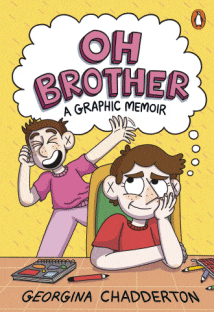
Oh Brother
Oh Brother
Georgina Chadderton
Penguin, 2026
288pp., graphic novel, RRP $A19.99
9781761046346
A brief glance at the blurb of this debut graphic novel suggests it is a situation that will resonate with many students…
New house. New school. New best friend? For a nervous kid who doesn’t like change, it’s a lot to deal with.
But there the comparison ends for most because this is not just another story about such a familiar situation, particularly at this time of the year. Subtitled “a graphic memoir” it is the real-life story of Gina, the author, growing up alongside a brother with high-needs autism and an intellectual disability, including being almost non-verbal with a unique way of communicating with his family, at a time when autism was scarcely understood by lay people, let alone accepted as a genuine disability. Even though great strides had been made in schools, children like Rob were seen as the “naughty” children, confrontational, disruptive and therefore unaccepted and isolated from “normal” children.
So while it’s tough enough for Gina to transition to high school in a new neighbourhood where neither she nor her brother’s needs are known, and all the changes that that brings, without the additional challenges of puberty, having a brother who “causes chaos” adds another dimension. Although the need for strict routines, and locks on doors and cupboards to keep Rob safe and as balanced as possible are normal for Gina, the situation is strange for those outside of the family and so making friends and participating in commonplace events is not easy for her.
Told in comic format which is Chadderton’s preferred medium to express herself, it explores her childhood in Adelaide and the impact living with Rob has, but rather than being dramatic and self-centred, its purpose is to educate and advocate for understanding, tolerance and acceptance, and, in the process, not only gives others in similar circumstances a voice, but also says, “You are seen and understood.” Explanations for such things as Rob’s meltdowns and what to do when one happens are sensitively addressed in the context of the characters’ conversations as well as cartoons which clearly explain the signs to look for such as hunched shoulders, fingers in his ears and “the air feels electric”. Yet, rather than frustration, there is a strong undertone of love, joy, resilience and it-is-what-it-is.
Author’s notes explain her purpose and that while, on the whole, it is true, memories can be fickle and change with time and perception. We learn where Rob is now, and also that Gina, too, was diagnosed on the Spectrum at 32, but although she suspected that she might have been, that hasn’t influenced her story-telling.
Usually, books for upper primary plus students would be passed on to reviewers for that age group because the focus of this blog is stories to encourage younger children to read, but this is such an important one that achieves what the author set out to do so well – educate, advocate, and give a voice to others in a similar situation – that it needs to be as widely shared as possible. One to add to the collection and let all the other Ginas read.