Archives

Pablo and Splash: Roman Holiday

Pablo and Splash: Roman Holiday

Pablo and Splash: Roman Holiday


Pablo and Splash: Roman Holiday

Sheena Dempsey

Bloomsbury, 2025

240pp., graphic novel., RRP $A18.99

9781526662859

Pablo and Splash are two penguins, living in the icy waters of Antarctica – best friends but very different because Splash loves adventure while Pablo is more content in his familiar world.  Since falling down a hole in the ice into the clutches of Professor O’Brain and her Timebender machine and finding themselves on a beach which they shared with dinosaurs, and then having to rescue the professor from being trapped in the Ice Age, they have become friendly with her so when they are challenged by Benji to go back in time to the Roman Empire and prove that they can travel through time and that they do indeed visit Rome by bringing back a gladiator’s helmet during a lesson about the era, it’s a dare they can’t resist, even if Pablo is a little reticent to begin with.

While Splash wants to explore the sites and sensations, and Pablo just wants to get the helmet and get back, they run into trouble when meet an emperor with a passion for collecting exotic birds, only some quick thinking – and emergency time travel – can save them from the fate that awaits them in the Colosseum!

With its graphic novel format, endearing characters and factual information mixed with time-travel adventure and humour, this is a series that both entertains and educates, as its  young readers learn about past practices and traditions as well as how some birds, and indeed animals, became endangered or even extinct. There is further information about some of the things the friends encounter at the end of the book, inspiring those with an interest to delve deeper.     

Full colour illustrations which cleverly convey the characters, expressions and emotions of birds that are usually portrayed as  the opposite, and the fast-paced plot carried along entirely in dialogue and speech bubbles, this is one that will entice not only the reluctant reader to immerse themselves in a book but also show those who believe history has no place in the present or future to discover that there is much to discover! 


R.I.P. Nanny Tobbins

R.I.P. Nanny Tobbins

R.I.P. Nanny Tobbins


R.I.P. Nanny Tobbins

Lucie Stevens

HarperCollins, 2025

304pp., pbk., RRP $A18.99

9781460766521

When Nanny Tobbins fell off a horse and broke her neck, the grown-ups told nine-year-old Albertine she’d never see her beloved governess again. But it simply isn’t true. For every night, when the clock strikes twelve, Nanny returns to the nursery.

Yet in her new ghostly state, Nanny Tobbins quickly causes chaos in the household — and the timing couldn’t be more inconvenient. Albertine’s stepmother is struggling to settle in, and Papa is much occupied working with Prince Albert on the Great Exhibition.

To make matters worse, the grown-ups don’t believe in ghosts at all, leaving Albertine to take the blame for Nanny’s unruly antics.

How will Albertine restore peace to her home before the unthinkable occurs?

This is a rare novel that kept me reading past my bedtime as I was drawn back into the era of Victorian England where the differences in the lives between the haves and the have-nots was so vastly different, particularly for children.  And to be honest, I wonder whether it would be better to be in the world of Oliver Twist where you survived by your wits and daring but which at least offered you some sort of freedom and friendship, or to be in the pampered situation of Albertine, where you had all that you needed except love, attention, but lived your life in almost total seclusion and solitude because children were “seen but not heard.”  For although Albertine’s father brings her gifts when he returns from his numerous trips – although this time the “gift” was a stepmother with no interest in Albertine at all – there is a limit to the time material things can engage you. 

All Albertine really wants is for those around her to acknowledge her existence – she wants to keep her Papa pleased with her, have her new stepmother at least acknowledge her existence, and not upset her beloved Nanny Tobbins who doesn’t seem to realise she has passed – so to be blamed for all the things happening around her is devastating. But, despite ‘living’ well over a century ago, Albertine is still a relatable character for today’s readers as she is smart, curious, brave enough to ask questions and yet still has the same concerns and worries that today’s children have.  Childhood is universal, and spans time and space, and astute readers will not only pick up the parallels with their own lives but also the difference between how they might deal with the situations and how Albertine did.  They will feel for Albertine whose closest bond in life is with a dead person despite her friendships with Susan and Blot, while learning that even if someone close to them has passed the connections and love endure through memories and dreams. 

Set in 1851 when Queen Victoria had been on the throne for 14 years and life in England was very much dictated and determined by social class – wealthy or working class, but with the gradual emergence of a new ‘middle-class’ as money earned through the developments of the Industrial Revolution began to filter through to the “nouveau riche”,  Steven’s story offers an insight into this pivotal period in history – it has been longlisted in the Children’s and Young Adult category of the 2025 ARA Historical Novel Prize – as well as being a whimsical yet serious introduction to the ghost genre, particularly as ghosts were an accepted part of life at the time as souls wandered between heaven and hell seeking their final resting place in the afterlife. – perhaps even an opportunity to delve deeper into the origins of Hallowe’en.

This is more suited for independent readers at the upper end of the audience for this blog, but one that will keep them engaged, indeed, engrossed as they are compelled to find out what happens to Albertine… And the publishers suggest that if they enjoy this then readers could venture into both  the Elston-Fright and Nevermoor  series, thus broadening their reading adventures even further.

On Gallant Wings

On Gallant Wings

On Gallant Wings


On Gallant Wings

Helen Edwards

Riveted Press, 2025

288pp., pbk., RRP $A17.99

9781763526051

Darwin, December 1941.  Even though her dad is a navigator for the RAAF and is stationed somewhere overseas, for 12-year-old Ava the war is a distant thing and she goes about her daily life with her mum and older brother Fred, playing with her best friend Kazuo, whose dad was born in Japan, and raising her pet pigeons. She lives by her own self-imposed rules and rituals and her greatest delight is watching the progress of her new chick Essie, her favourite pigeon, who is already showing signs of leadership, ready for her first flight early. while dodging Billy the Bully is her greatest fear.  Life is okay, under the circumstances – until it isn’t.

Fred lies about his age so he can join up and “do his bit” and is to be sent to training camp shortly; Pearl Harbour is bombed by the Japanese and Kazuo and his family are sent to an internment camp, even though both Kazuo and his mother were born in Australia; and then Darwin, itself, is bombed and Ava and her mum barely escape with their lives.  Forced to evacuate, Ava and her mum join the other families in making the long and arduous trip south to stay with Grandma Dot and Grandpa RaRi in Lake Boga near Swan Hill, Victoria, a town as different from Darwin as it could be. And such a change means a new set of rules -including the one about making no new friends because everyone leaves anyway. Yet despite the difference in location, the war follows Ava, both in reality as a secret Catalina flying-boat maintenance base is built on the lake and her mother joins the WAAAF and works at the base,  and in her head as the sights and sounds of the bombing continue to haunt her.  Infrequent letters, heavily censored, keep her in touch with her dad and Fred who is now with the Signals Directorate working with Essie and the other pigeons in preparation for deployment to New Guinea and despite her rule not to make friends because friends leave and heartache follows, she teams up with Pete, Jenny and Stevo and with school and swimming in the lake, watching the Catalinas and the pelicans, there is a semblance of normality again. That is, until her life is turned upside down when Kazuo appears in the dead of night having escaped from the family internment camp, terrified of being send to the single men’s camp where Japanese prisoners of war will see him as a traitor to their nation. Ava is torn between helping him and living by her rules of telling no lies to her grandparents… Can she find a way through her ethical dilemma so she doesn’t break her grandparents’ trust, can keep Kazuo safe and yet remain true to her self?

Written by Ava, and interspersed with those precious letters, this is an intriguing and engaging story for independent readers about a little-known period of Australian history.  While even our youngest have a sketchy knowledge of why we commemorate ANZAC Day, the wars and the conflict and upheaval they caused, are fading into the memories of even their great-grandparents now and the stories of the children’s lives of the time are disappearing. Life before the internet is tricky to remember, let alone life before television, and so a war fought in a time when soldiers had to roll cable out through the jungle and rely on carrier pigeons for communication is almost unimaginable and so this is an important story for giving today’s readers a glimpse into a life that was very real for their great-grandparents, and ultimately influenced who they, themselves, are. (My own grandchildren proudly volunteer as flag bearers each ANZAC Day at the Australian War Memorial, commemorating the service of their great-grandfathers, grandfathers and other family members, continuing that contribution to community through their Scouting activities.)   Meticulously researched, it also fills in gaps for those of us who are older but whose parents chose not to talk about their wartime experiences – too raw, too scary and too incomprehensible if you weren’t there and didn’t live through it.  It may even spark an interest in investigating personal family histories, or perhaps the story of someone whose name is etched on the town’s war memorial. 

As well as Ava’s own experiences, there are also broader issues that can be discussed and explored such as the automatic internment of those Australians deemed to be enemies because of their heritage; the secrecy surrounding the devastation of Darwin;  even the impact of PTSD on children and how seemingly unrelated events can cause triggers.  More general teaching notes following these themes and others, including the uncensored letters, are available here.

Through Essie, Tommy and the other pigeons, we also learn about the role they and other animals have played in wars -so many  more than Simpson’s donkey – and those with an interest can not only read about the Dickin Medal which was awarded to Essie, but can also read more in Pidge’s Poppies and Wear a Purple Poppy

Given the unpredictability of today’s world, the 24/7 news cycle and television and the internet bringing the world’s conflict into our students’ lounge rooms, many are feeling great anxiety about their future so want to escape into fantasy adventure where they have the power to control events, but with carefully selected historical fiction such as this, we can show them that previous generations have faced just as dire circumstances and come through – challenged and changed, but resourceful and resilient – and that there is hope for them too.  Humanity will prevail.

From pigeons and Morse code to satellites and cyberspace: 100 years of the Royal Australian Corps of Signals

"Rat on wings": the little pigeon that won a gallantry medal

“Rat on wings”: the little pigeon that won a gallantry medal

Pablo and Splash: Frozen in Time

Pablo and Splash: Frozen in Time

Pablo and Splash: Frozen in Time


Pablo and Splash: Frozen in Time

Sheena Dempsey

Bloomsbury, 2024

240pp., graphic novel, RRP $A17.99

9781526662804

Pablo and Splash are two penguins, and even though they are very different in that Pablo loves his icy home and Splash is sick of the cold, they both agree that a holiday would be a good thing.  But it’s tricky when you live at the bottom of the planet in Antarctica and warm places are too far to swim and without wings, you can’t fly.

But Antarctica means there are scientists nearby and surely they have a solution…  And that’s how they discover Professor O’Brain and her Timebender machine who sent them to the sunny beach they craved but they found themselves sharing it with dinosaurs.  In this second episode of the series, they decide to visit Professor O’Brain again to see if she has mended the machine, but both are determined that they will not end up in some weird destination this time, especially as this time they know where the secret hole takes them.  

However, instead of finding her in her lab as they expect, they discover the time machine has misbehaved again and this time it is the professor, herself, who has been stranded in the Ice Age.  Clearly, Pablo and Splash must help her  and so the brave penguin buddies set out on a rescue mission – destination 68,000 years ago! When a Neanderthal man accidentally wanders into their time machine, it’s not just the professor who is stuck in the wrong time period. But luckily a scientific breakthrough for Pablo and Splash’s endlessly upbeat approach to life’s challenges helps save the day!

Graphic novels, time travel and familiar, appealing creatures on a rescue mission are the right ingredients for a story that will engage young readers and with its bright, full-colour illustrations that carry the story along with just speech bubbles as text there will be many who could be enticed to pick up a novel-length book for the first time. 

As with the first one, it’s an opportunity for the reader to think of where the next adventure might take place, who or what Pablo and Splash might encounter and perhaps research and write their own story.  Perfect for the CBCA Book Week 2025 theme of Book an Adventure. 


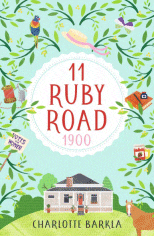
11 Ruby Road: 1925

11 Ruby Road: 1925

11 Ruby Road: 1925


11 Ruby Road: 1925

Charlotte Barkla

Walker, 2024

176pp., pbk., RRP $A16.99

9781760657956

It is 65 years since Millie and her mum moved to 11 Ruby Road and began Millie’s Store, and 25 years since Dorothy wrote her play inspired by the fight for the rights of women, and now it is the turn of the Muellers, a German-Australian family who have moved from Ipswich. to begin their life there where there is opportunity and jobs for his mother and older siblings, even though they have had to change their name to Miller.   Ten-year-old Bert’s father has been deported back to Germany following the conclusion of World War I, but there is still deep suspicion and distrust of anyone with connections to that country and so as well as trying to fit into a new school where cricket is king but your love is music and reading, Bert also has to contend with the attitudes of those whose lives have been so profoundly affected by the conflict and who hold all Germans responsible. –

But, in a time where entertainment and good times are pursued as an antidote to the horrors and restrictions of the previous decade,  Bert’s love of jazz and his ownership of a gramophone offer him an opportunity to make new friends, and although his plans are thwarted at first, following the near drowning of his younger brother Friedrich there is a chance for a second chance – one that reveals that Bert’s is not the only family with overseas heritage, and sets a few lives on paths very different to that which they anticipated. 

With some references to the past story including the reappearance of the pink ribbon given to young Millie back in 1860 as it binds the inhabitants together, but otherwise a stand-alone story, this is the second in this series  tracing the stories of the occupants of this house in Brisbane, introducing young independent readers to the lives of those who lived in the times, as well as the genre of historical fiction.  As with the predecessor it opens up avenues for discussion about how children lived – and there are notes at the back that expand on this – and extensive teachers’ notes support a more in-depth study for more mature readers, particularly the treatment of Germans post-war.  As the daughter of one who was held in captivity in Stalag VIIB for many years and then force-marched across Poland as part of a human shield and the daughter-in-law of another who knew Changi and the infamous Burma Railway first-hand,  I understand the prejudices that adults  like Mrs Purcell hold, but like Bert, younger readers might find this difficult to grasp particularly as both he and his siblings were born in Australia. Perhaps it is the children’s unity through playing cricket without regard for life through the adult lenses of what was and what should be which Hildegard is encountering, that can be the lasting legacy and set up the next chapter in the series as well as new friendships and understandings applicable even today.

Pow Pow Pig 6: Forest Secrets

Pow Pow Pig 6: Forest Secrets

Pow Pow Pig 6: Forest Secrets


Pow Pow Pig 6: Forest Secrets

Anh Do

Peter Cheong

A&U Children’s,  2022

224pp., pbk., RRP $A16.99

9781761069833

It is the year 2050 and the world is in trouble. In 2030 the rich animals of the world voted to stop helping the poor and as they became richer, forever seeking bigger and better while discarding their unwanted things instead of sharing them, creating a huge amount of waste.  And then the fighting started.

But all is not lost and Piccolo Pig (aka Pow Pow Pig) , inspired by his parents’ role model has yearned to join CHOC (Creatures Helping Other Creatures) to help make the world a better place through small acts of kindness. So as soon as he was old enough he joined, and now, after three years of training it’s Graduation Day. But he and his friends Danielle Duck (aka King Fu Duck), Chelsea Chicken (aka Cha Cha Chicken) and Barry the Goat (aka Barry the Goat) are not in the A Team but the Z Team.  So they are the last to be picked when it comes to world-saving missions.

So when a call comes in and they are the only ones left, it is up to them to save the situation.  Although they live in 2050, they have time machine that allows them to travel back in time but sometimes it doesn’t work as it should so instead of ending back in 2030 as they want, they land in a variety of different time periods of the past. In this, their sixth adventure, they are in the forests of Ancient Japan caught in a chaotic fruit fight between two rival groups, the foxes and the monkeys, the once-peaceful forest is now divided and the team is determined to investigate how the conflict started so perhaps the issue can be resolved and harmony restored. 

The series is designed for younger independent readers with all the attributes required to support their transition to novels including a larger font, a light-handed layout and many illustrations, But, as with his other series embedded in the thoroughly modern characters, action, adventure and humour, there is an underlying message that gives the story more than just fleeting entertainment value. With their real world in such a tumultuous state with overseas situations touching those in Australia daily, this is a story whose underlying themes of getting combatants to recognise, understand and forgive long-held grievances, build bridges, work together and build a brighter future is very relevant and gives it substance that it relevant and thought-provoking so that there is a glimmer of hope on the horizon.   

By making the heroes creatures often associated with being underdogs and having them as the Z Team readers can learn that success can take many forms, that not all battles are won with might and power – a tea towel and a broom can be very effective when used cleverly – and that the desire to do well has to come from within. Perhaps they might even be inspired to stretch a hand across the desk to someone with whom they haven’t been seeing eye to eye and begin the peace process.   If Pow Pow Pig can do it, so can they. 

Hester Hitchins and the Falling Stars

Hester Hitchins and the Falling Stars

Hester Hitchins and the Falling Stars


Hester Hitchins and the Falling Stars

Catherine Norton

HarperCollins, 2024

256pp., hbk., RRP $A22.99

9781460763179

London. 1866. And Hester Hitchins’ life has been turned upside down.  Her mother has died while giving birth to twins, and her father is “Missing, presumed dead” when the ship he served on burned and sunk on the high seas.  So Hester, the twins, and her brother and sister have been sent to live with their unmarried Uncle Henry, not for altruistic reasons but because he sees the older three as free labour.  Her older sister Joyce is immediately made the housekeeper including raising the babies, Horace becomes his apprentice in his rope-making business and Hester, herself, is pulled from school which she loves, to spend her day braiding the dreaded whip known as a cat-of-nine-tails.  (She is so disgusted and fearful of them that she only makes them with eight lashes, but that proves to be her downfall.)

Life is so different and not easy for the children and Hester is convinced that her father is still alive – after all, “presumed” does not mean definitely.  As a young girl he taught her about the stars and their movements, particularly the Pole Star, and told her that as long as he had a compass, a telescope and could see the Pole Star he could find his way home to her. And so Hester believes that with the same tools, she should be able to find her way to him.  Under scary circumstances she gains a lodestone,  but her life changes again when she surreptitiously enters a test for admittance to Addington’s Nautical Navigation Academy, and wins a scholarship – at the same time that her deception with the whips is discovered and Uncle Henry decides to send her to be a scullery maid – the most a girl of her age and position can hope for in those times.

With the help of her sister Joyce, Hester dues find herself at the Academy but the problem is – it is only for boys!  

This is a glorious adventure story for independent readers that has a cast of intriguing, well=crafted characters, each of whom shines a spotlight on the customs and conditions of the time, not the least of which is the circumstances of girls, oppressed by their gender.  Many will see themselves in the resourceful, problem-solving, never-say-die Hester as she encounters problems and obstacles that only her determination and her new friends Nelson (despised by others at the school because of his Asian heritage) and Pru (a nature-loving girl who collects insects to draw), not to mention the wise Marguerite,  and will want to keep turning the pages to see if she does indeed discover what happened to her dad. 

Loosely based on real-life characters of the time including Janet Taylor  an English astronomer who was an expert in nautical navigation, and Mary Ward  whose stories are outlined in the author’s notes, this is a story that will lead the reader down many rabbit-holes (as it did the reviewer) not the least of which is a reflection of how life has changed so much for girls, particularly, in 150 years.  Once again we give thanks for the courage and determination of those on whose shoulders we stand.  

Murray The Knight

Murray The Knight

Murray The Knight


Murray The Knight

Adam Stower

HarperCollins, 2024

192pp., pbk., RRP $A15.99

9780008561277

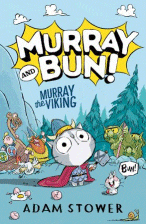
Murray the cat enjoys living the good life with Fumblethumb the wizard, a life made even better when Fumblethumb accidentally turns one of Murray’s favourite buns into a bunny, complete with a cherry for a tail.  But when he messes up again and turns the cat flap into a gateway to adventure, instead of just the garden, then the fun really starts…

In this new series for newly independent readers consolidating their skills, the cat flap takes Murray and Bun back to medieval times when knights did daring deeds and they find themselves on a mission to defeat Sir Nasty in a jousting competition, rescue Princess Rubytoes… and try not to get lost in the maze.

Simple text,  humour and full of illustrations that carry the story along at a rapid pace, and using the popular trope of a portal to travel through time,  this is a great stepping stone between instructional readers and novels that will have wide appeal because of its outlandish characters and original adventures, as well as introducing the reader to historical fiction, perhaps sparking an interest in the time period and piquing their interest to find out more..  Something new to offer those moving forward on their reading journey as they go through their own cat flap of adventure to the world of stories.

The Girls Who Changed the World (series)

The Girls Who Changed the World (series)

The Girls Who Changed the World (series)

The Girls Who Changed the World (series)

Ming & Flo Fight for the Future

9781460760208

Ming & Marie Spy for Freedom

9781460760215

Ming & Hilde Lead a Revolution

9781460763445

Ming & Ada Spark the Digital Age

Jackie French

Harper Collins, 2022-2024

288pp., pbk., RRP $A16.99

If ever there were a series that encapsulated the 2024 CBCA Book Week theme of Reading is Magic, then this would be it.  By opening any of these books and reading the stories, the reader is transported to a different place and time in history to meet real people, largely unacknowledged because they are female, and to learn about the significant contribution they made then that still impacts our lives today.  What could be more magical than that?

When Ming Qong puts up her hand in Mr Boors’ history class and asks him why they only ever learned about men in history, never girls, she has no idea the chain of events that she was about to set off.

Suddenly the class is silent and still, as though frozen in the moment, except for a strange, almost ethereal woman dressed in purple sitting in the window sill -someone Ming feels she knows but doesn’t.  The woman introduces herself as Herstory, the sister of History, a woman passionate about the part women have played alongside men as the centuries have rolled past and is as frustrated as Ming that those stories have not been told because “men wrote the history books and they mostly wrote them to please kings or generals or male politicians.” Even though the women’s stories are there in letters, diaries and even old newspapers waiting to be discovered, the past has always viewed through a male lens.  She then offers Ming a way to travel back to the past for just 42 days, to see it for herself (even though it wouldn’t always be pleasant, pretty or comfortable) and be part of it although she, herself, would not be seen or heard and she couldn’t change anything that happened.

And so the reader is transported back into times past to experience what life was like for girls and women when men were viewed as superior beings in all ways, and females were merely appendages to cater to their whims.  Few had the courage, the independence of spirit, the opportunity and the wherewithal to stand up to make a difference but when they did, they began the changes that have led to the life we lead today.  Whether it is having a say in the governance of the country; putting the contribution and sacrifice of women in war in the spotlight; the contribution that they made to developing Australia’s  wool industry allowing the nation to “ride on the sheep’s back for so long; fighting the scourge of racism and letting a female’s intelligence shine, this series tackles so many issues that women have been confronted with and challenged over centuries. And, just as we are currently discovering the stories or hardship, perseverance and endurance behind our Olympians, so the reader learns that there is much more to the stories of the women that we hold as heroes – it is their hidden histories of facing and fighting convention, prejudice, opinion and oppression, that helped them become who we see them to be today.  

However, as well as telling the stories of these remarkable but very ordinary (in the beginning) people, there is also Ming’s own story unfurling and there is a sense that for her too, there is something more to come, that these adventures and revelations are all leading to something momentous for her.  

Jackie’s meticulous research and her ability to tell a story that is so engaging that the reader wants to learn more once again shines a spotlight on the women on whose shoulders we all stand and for whom we owe a strong debt of gratitude.  

And there is still one more to come in the series.  Bring it on.  


Jack’s Island

Jack’s Island

Jack’s Island


Jack’s Island

Norman Jorgensen

Fremantle Press, 2024

224pp., pbk., RRP $A17.99

 9781760992958

World War II, and following the bombings of Darwin, Broome and Onslow, the threat of a Japanese invasion of Western Australia looms large.  Jack’s father, with his specialist skills in road-making, is one of many required to go to Rottnest Island to construct an aerodrome as a first line of defence should Perth be attacked.  

As the local ferry Valkyrie hits turbulent seas on the journey there, with all but Jack hanging over the side in dire straits, it does not presage well for this to be a smooth period in young Jack’s life, and as he himself says, “I’m not that bad – I just get caught a lot.”  Jack soon teams up with Andrew “Banjo” Paterson and together, they find themselves in all sorts of strife as they just do the things that boys of that age in that era did – being in school where corporal punishment at the hands of stern schoolmasters was the norm, building billy carts and canoes, being where they shouldn’t because they are fascinated by what’s going on around them, climbing cliffs and trees with the inevitable consequences….

But as much as this story is about the derring-do of lads who find reserves of courage and resourcefulness they didn’t know they had, it is a story of friendship and loyalty and the acceptance of people for who they are as they are that only seems to happen amongst children.  This is particularly true when it comes to protecting the intellectually-challenged Dafty, and when he is lost overboard at sea, the boys are devastated. 

Norman Jorgensen has delved deep into his family’s past, particularly his father’s adventures on Rottnest during the war, and from this has created something unique – a story that shines a light on a past time when life was much more carefree in some ways, but also so much more restricted in others, not the least being the continuing prejudice towards those who are different in any way as well as rationing, conscription, and the threat of invasion hanging overhead especially when the boys find the helmet and rifle of a Japanese soldier at the base of a cliff. But for all that, there are times when it is LOL funny, and tear-in-your-eye serious, with endearing characters that took me back to my own childhood in post-war years when we roamed our local shoreline freely told to return only “when the tide turned or it got dark”. 

When this was first released, it won the WA Young Readers’ Book Award 2009 and was a CBCA Notable for that year, awards that were thoroughly deserved.  Now, re-released in a new livery, it remains an excellent read, one that will entertain and engage a new generation, including all those young lads who will see themselves in Jack and Banjo.    

To add an essential extra to the read, complete with actual photos of the time, be sure to watch and share this  remarkable book trailer