Archives

Blue: Dragon of the Sea

Blue: Dragon of the Sea

Blue: Dragon of the Sea


Blue: Dragon of the Sea

Aleesah Darlison

Tamlyn Teow

Wombat Books, 2026

32pp., hbk., RRP $A26.99

9781761112706

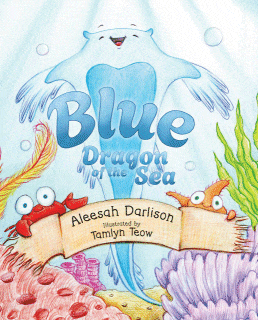
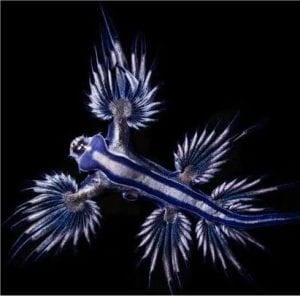
Despite its title, this is NOT the story of a winged, fire-breathing dragon who has fallen into the sea and found a home there. Rather it is the story of another of the almost-unknown creatures that live beneath the surface of the sea. With a name pronounced “nudi-brank” and meaning “naked gills”, nudibranchs are probably as far removed from those mythical flying creatures as you can get because they are commonly called sea slugs, come in all shapes, colours and sizes, and there are over 3000 different types. 

Blue, in particular, is a blue glaucus or Glaucus atlanticus and between Darlison’s lyrical text that flows just as Blue does, and Teow’s imaginative, colourful illustrations, young readers with a fascination for what’s under the waves can learn about these little creatures that don’t have brains but do have a special trick for keeping themselves safe.

But as well as being “tiny ballerinas of the sea”, with their rapid life cycles, are especially sensitive to changes in their environment, making them invaluable indicators of broader marine ecosystem shifts, particularly those induced by human activities and climate change and so there is a citizen science project for those with a deeper interest to become involved in, particularly those with access to the Great Southern reef from Kalbari in Western Australia, around southern Australia, to Caloundra in south-east Queensland.

If ever there were a need to maintain a robust non fiction print collection, particularly for younger readers, then this is the sort of book that is a role model.  How many adults have heard of these tiny little creatures, let alone children? (As a former scuba diver, I had but…) So when you don’t know what you don’t know, how do you know to look for them online?  Serendipitous discoveries of books like these with their intriguing covers and titles, enticing illustrations and accessible texts as young readers browse displays or the manageable collection of print resources (as opposed to a zillion unsorted websites)  can spark a thirst to know more and perhaps establish a dream for the future.  

Whether it’s punk turtles, endangered rainbow birds, bouncing woylies, captivating capybaras, or any of the other fascinating species that Darlison has woven stories around to encourage young readers to celebrate the natural world with her and to better understand the interdependence of the ecosystems and the threats they face,  each story offers something new to investigate as the often-unseen world is brought into focus.  And awareness is the first step in appreciation and ultimately, conservation. 

Tilly’s New Adventure

Tilly's New Adventure

Tilly’s New Adventure


Tilly’s New Adventure

Rhonda N.  Garward

Little Steps, 2025

32pp., pbk., RRP $A16.99

978-1-923306-33-2

On a still, moonlit night over 10 years ago, a mother turtle laid her eggs in the sand of a Queensland beach and eight weeks later, Tilly emerged and managed to avoid all the onshore and offshore hazards of being a baby green turtle making its way to the sea and growing up. During her time out in the open ocean she ate jellyfish and small fish, but now she is a teenager it’s time for her to return to the reef to seek out seagrass that she needs so she can become bigger and stronger, so that when she is about 30 years old she can return to that beach where she hatched to lay her own eggs, perhaps even living to be 100!

It’s a long journey back to the seagrass fields and there are many ocean friends to guide her on her way, but even though she is so much bigger and more mature than that little baby that waddled down to the water, there are still hazards and dangers to avoid, like abandoned fishing nets.  And when she gets tangled in one, cannot swim and is washed ashore, it looks like getting to the seagrass is not going to happen, let alone being mature enough to lay her eggs or live to 100!  Until…

Like its predecessor, this new release is beautifully illustrated with all the creatures and colours of the reef faithfully portrayed, made even better by each page having a flap that lifts out to show even more!  A final double page spread identifies those featured in the book so budding marine biologists can investigate further, while there are thumbnail sketches of those that Tilly specifically encountered on her return to the reef.  There is also information about green turtles, the Great Barrier Reef, seagrass as well as what the reader can do to help minimise the dangers to the turtles. 


A peek inside...

A peek inside…

Even if young readers haven’t met Tilly as a baby, this will still fascinate them and perhaps even encourage them to want to learn more about what lives beneath the waves, and what we as humans can do (or not do) to protect them.  


Flute: A Dolphin’s Wild Journey Home

Flute: A Dolphin’s Wild Journey Home

Flute: A Dolphin’s Wild Journey Home


Flute: A Dolphin’s Wild Journey Home

Kasey Whitelaw

Jenni Goodman

Wombat Books, 2025

32pp., hbk., RRP $A29.99

9781761112294

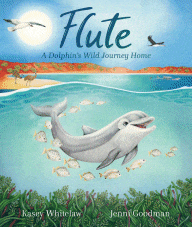
On Australia’s west coast in a sheltered cove called Monkey Mia, Flute the baby bottlenose dolphin, lives a carefree life playing with her friends, but always wary of the dangers around her – after all, Monkey Mia is part of a larger region called Shark Bay – and always ready to respond to her mother, Piccolo’s whistle and seek safety in the middle of her party.  That is, until the day a noisy boat motor rips through the ocean, and curious Flute, drawn to this new sound, is not only separated from the others but is lost and confused. Will she find her way home safely, or will she fall victim to the many dangers that lie in wait for a baby dolphin alone…?

Based on true events which are explained in the final pages of this beautifully illustrated book, young readers are introduced to all sorts of marine life that lives beneath the seemingly tranquil waves of this world-famous sanctuary, as well as those that call its shores home,  as they will Fluke on to find her mother and safety, particularly when a tiger shark comes looking for an easy feed. Each of the creatures is then identified in vignettes on the endpapers so young nature lovers not only appreciate the biodiversity of this small area of coast but can investigate those that catch their eye.

In a Q & A with the author, herself a marine biologist who worked with Flute and her family for seven years, giving the book real authenticity, says, her aim was “to create a narrative that would ignite empathy and inspire readers   to step back, observe, and get curious about the lives of all dolphins” and this is certainly going to do that because it is books like these, that combine real life with storytelling creating an engaging narrative that leave young readers to not only be more aware of their natural world around them but actively protect it.

.

An A-Z of Ocean Creatures

An A-Z of Ocean Creatures

An A-Z of Ocean Creatures


An A-Z of Ocean Creatures

Myke Mollard

Woodslane Press, 2025

48pp., hbk., RRP $A29.99

9781923350038

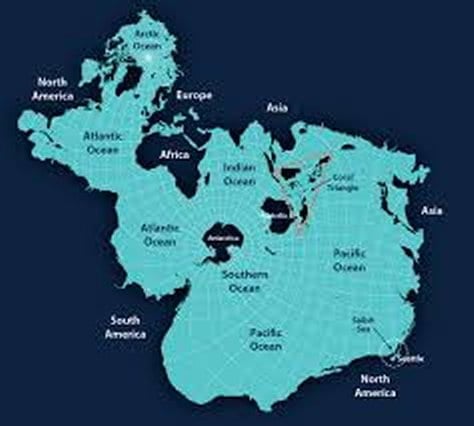
If you look at a globe of our planet, it looks like there is more land than ocean, when, in fact, over 70% of the Earth’s surface is covered by seas and oceans and from space it looks like a big “blue marble.” However, if you view it through “a whale’s eye view” offered by the Spilhaus Projection with Antarctica at its centre and which takes up this book’s endpapers, it is clear that these oceans and seas are interconnected, forming just one mass of water.  

The Spilhaus ProjectionSeattle Aquarium

The Spilhaus Projection- Seattle Aquarium

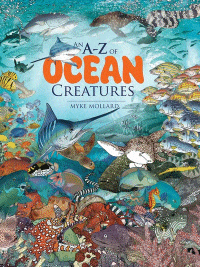
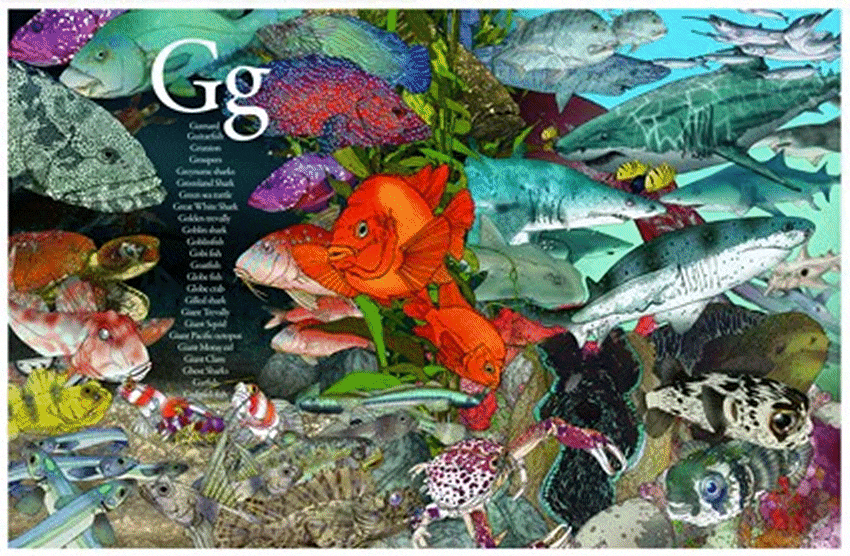
Within that, are an estimated 2.2 million marine species, with only about 242,000 to 243,000 described so far., and if those over 600 – including majestic sharks and colourful fish and corals to fascinating molluscs like octopuses and nudibranchs, as well as crustaceans, reptiles, birds and the awe-inspiring whales and dolphins –   are showcased in this new release from Myke Mollard and Woodslane Press.   With his characteristic, vibrant illustrative style, Mollard has selected and sorted these creatures by alphabetical order, depicting them with anatomical accuracy on large, double-page spreads, and then meticulously identifying each in vignettes in the closing pages so young readers can dip and delve and discover more if they choose. 


A peek inside...

A peek inside…

Search this blog for “Mollard” and you will discover many more of the remarkable works of this man who is driven by his passion for connecting kids to Nature, and you will realise that, as with its predecessors, this one truly hits that mark.  And although many of those species that are featured in this book may not be those children are likely to encounter on their beach holiday, nevertheless there are some just waiting to be discovered, identified and serve as inspiration to know more.  This takes Finding Nemo to a whole new level of exploration – especially through the 591.77 section of the collection. . 

The Messy Bath Monster

The Messy Bath Monster

The Messy Bath Monster


The Messy Bath Monster

Tina Wilson, Joan Wilson & Matt Ottley

One Tentacle, 2025

32pp., hbk., RRP $A26.99

9780648511946

Whenever Monkey has a bath, there is always a big mess left behind so he is convinced that there must be a monster lurking there.  He wanted to tell it to stop leaving such a mess, so, being a brave monkey, he decided to go in search of it…

We first met Monkey a few years ago when he took a trip to Venice, and now the little knitted toy is back on a new adventure that involves all sorts of undersea creatures – again, all handknitted by the author’s mother and photographed against real-life backdrops.  But as well as the visual experience, there is also an auditory one as award-winning artist Matt Ottley has created a unique musical score to showcase and connect the images, words and music from this and the many other picture books he has created, which can be downloaded for free.(There is both a QE code and a link to access these included with the book, as well as links to the knitting patterns.)

With the CBCA’s 2026 theme being “Symphony of Stories”, this would seem to be perfect timing to introduce children to both the concept of a multi-modal experience, either of this particular book or Matt’s others which include masterpieces such as The Colour of Music, How to Make A Bird, Teacup and Parachute.   

Sadly, I have had an infection which has left me temporarily deaf so I can’t hear the music to comment on it, but this is a brief trailer which will be part of live performances taking place in Western Australia in October 2025 (perhaps in NSW and Queensland in 2026) as part of The Sound of Picture BooksTM initiative.  Opens up all sorts of possibilities to investigate instruments, the sounds they make, and then, like Tchaikovsky’s Peter and the Wolf, have the children consider which would be best to represent each character. What other creatures might Monkey and Octopus meet and what would be appropriate music for them? 

No harm in starting the Book Week 2026 experience early!

The Great Shark Egg Case Hunt

The Great Shark Egg Case Hunt

The Great Shark Egg Case Hunt


The Great Shark Egg Case Hunt

Kasey Whitelaw

Sylvia Morris

CSIRO Publishing, 2025

32oo., hbk.,  RRP $A26.99

9781486318308 

Noah lives in South West England with his grandad. Ava and her aunt live in False Bay, South Africa.  William likes to snorkel with his sister off the coast of South Australia, while Lily and her mum are in Kachemak Bay, Alaska.  Then there’s Koa in New Zealand, Sofia from the Philippines and Mai from the Maldives. Could these children be further apart?  Yet, they are all united by two things – they love near the coast and each is part of a global citizen science project called The Great Shark Eggcase Hunt, initiated in 2003 by the Shark Trust (United Kingdom) and launched in Australia in partnership with CSIRO in 2023. 

Sharks either give birth to live young or they are one of five key groups – catsharks, hornsharks, carpet sharks, chimaeras and skates – that lay eggs, and, despite being the among the ocean’s apex predators (the orca is at the top), some species are endangered.  So Noah, Ava, William, Lily and the others spend their time hunting for egg cases , which are tough, leathery shapes that protect the young inside as it develops, photographing and measuring their finds and then recording them on the database  so scientist can map the types of sharks and where they are living so they can learn more about habits and habitats.

So this book is not only packed with information about the various egg-laying breeds and what those eggs look like, but also has loads of tips for becoming a citizen scientist yourself and joining in the research.  The website also provides further details about becoming involved, particularly as there are egg-laying species found all around Australia’s shores, including the Port Jackson shark whose spiral-shaped egg cases always spark curiosity. And Sea Life in Sydney and Sea World Gold Coast are involved in the StAR Project  which is an international effort to restore wild leopard shark populations by sending viable, fertilized eggs to Raja Ampat, Indonesia, for release into protected marine areas. 


Port Jackson shark egg case

Port Jackson shark egg case

As our students become more and more aware of the environment around them and want to be actively involved in its protection, there are more and more citizen science projects that they can become involved in whether it’s the Aussie Bird Count, counting  Christmas Beetles, tracking bogong moths  or any of the many others that rely on the participation of ordinary people. Becoming a a shark egg hunter seems particularly appropriate for those who live on the coast, especially as the warmer months approach and this book is an excellent introduction, while teachers’ notes offer suggestions for investigating sharks generally. .


Find Me on the Coast

Find Me on the Coast

Find Me on the Coast


Find Me on the Coast

Jess McGeachin

Lothian Children’s, 2025

40pp., hbk., RRP $A29.99

9780734423634

‘Let’s walk down a winding path to where the sand meets the sea’

Is there anything more calming and relaxing than taking a walk along the beach, as the waves lap your toes like the planet’s heartbeat, the breeze brings in the clean, fresh air of vast emptiness, seagulls rise as one to wheel overhead  and every now and then you stoop to examine something more closely – tracks, seaweed, a child’s path tracked by a trailing stick…

Coasts wrap around all the land on Earth, and depending where and what they are, each offers untold treasures from Mother Nature, just waiting to be explored, wondered and marvelled at, whether they are salt marshes, coral reefs, rocky shores, mangrove forests, kelp forests, or seagrass meadows. The time of day also makes a difference – do you jump as hungry waves bury your footsteps as the tide comes in, or do you bed over and create stories in your head about what is  playing out in the rockpools left as it recedes?

Queen of all I could see...

Queen of all I could see…

As one who grew up with the beach across the road as my playground, investigating the hidden treasures that the tide left behind on the sand and in the rockpools has absorbed much of my life and this new release from Jess McGeachin who is so well known for creating books that draw you back again and again because there is always something new to discover, is treasure indeed.

From sunrise to sunset the reader is taken on a journey that takes them around the world’s different coastlines to discover just what calls each home, both plants and animals. With his usual eye for detail,  meticulous illustrations, including fold-out pages, and  accessible text enable the reader to think about what might survive and thrive on the coast near them, and how they do it, while also introducing them to different sorts of biomes where completely different species have grown and adapted. Maybe it’s the curlew with its long bill perfect for seeking out its own treasure in the sand or the lizards that hide on the tangled branches of the mangrove; the tiny fish that dart through the rockpool or the carefully camouflaged octopus lying in wait for them, there is so much to discover making the nest trip to the beach for the reader so much more than a splash in the waves and building a sandcastle.  

The good news is that this is Jess McGeachin opening up the world for our young readers to explore, understand and protect; the better news is that it is just the first in this new series…

Sid and the Very Hard to find Squid

Sid and the Very Hard to find Squid

Sid and the Very Hard to find Squid


Sid and the Very Hard to find Squid

James O’Hanlon

CSIRO Publishing, 2025

32pp., hbk., RRP $A26.99

9781486319664

Sid is on a mission – he has a list of the most obscure, hard-to-find creatures that inhabit this planet and he is determined to discover them all. He’s already ticked off tuatara and takahe and a host of others but the Colossal Squid Mesonychoteuthis hamiltoni is proving to be very elusive – probably because an full-grown adult has never ever been seen alive in the wild. (In April 2025,  an international team of scientists and crew on board Schmidt Ocean Institute’s research vessel Falkor (too) was the first to film the colossal squid (Mesonychoteuthis hamiltoni) in its natural environment. The 30-centimeter juvenile squid (nearly one foot long) was captured on video at a depth of 600 meters (1968 feet) by the Institute’s remotely operated vehicle (ROV) SuBastian.)  Adults are known to exist because of beaks that have been found in sperm whales and from these it is estimated to be at least 495 kilograms and maybe up to 700 kilograms and over 4 metres long, making it the largest invertebrate in the world.

Unlike the giant squid of Jules Verne’s 20 000 Leagues under the Sea or the real-life encounter in 1873 reported in  “Capture of a gigantic squid at Newfoundland,” The American Naturalist 8 (1874), 120-124., which focus on the species Architeuthis dux, which are longer but lighter and live in the North Atlantic, Sod’s squid dwells in the deepest, coldest waters of the Southern Ocean which circle Antarctica and in this cheerful, rhyming yarn he eventually ventures deep below the ocean’s surface.  But is he successful?

Comparison between giant and colossal squid

Comparison between giant and colossal squid

It’s probably obvious, that like a lot of these wonderful publications from CSIRO Publishing. that this one also led me down a number of rabbit-holes teaching me all sorts of things I didn’t know I didn’t know – and it’s likely to be the same for any young independent reader who picks it up.  While I am familiar with tuatara and takahe and a number of the other creatures that Sid encounters and he begins to understand that the journey can be just as intriguing as the destination,  I have a fascination with the Antarctic because of who my mum was, and I was a scuba diver in my younger days, there was so much to learn from what might, at first glance, be considered a book for young people.

As well as Sid’s engaging narrative and illustrations that make you want to discover more about the things he does find and cross off his list, there is more information about both the Colossal Squid and deep-sea exploration in the back matter that add depth and wonder to the whole experience.  And it might just lead a reader on to the Verne classic in novel, graphic novel or even movie format and from there… who knows? Perhaps they could even compile their own list of must-find creatures and ask themselves, “What do I need to know about this to discover it?”  Research opportunities… Definitely one that fits the CBCA Book Week theme. “Book an Adventure”.

Hairbrain Saves the Ocean

Hairbrain Saves the Ocean

Hairbrain Saves the Ocean


Hairbrain Saves the Ocean

Danny Katz

Mitch Vane

Walker Books, 2025

96pp., pbk., RRP $A15.99

9781760656515

Despite his nickname, Hairbrain is always thinking up new ideas, particularly those that help people live a better life or to save the planet.  In fact, he has a file of 10,782 ideas (approximately.)  However, when the family goes to the beach and Hairbrain dons his mask , snorkel and fins expecting to be able to see fish, dugongs and other underwater creatures he is very disappointed to discover nothing more than plastic bags, broken bottles and other rubbish left by humans. And so he invents a machine that he is convinced will clean up the ocean – if only he and his little sister can get it there.

This is a new series by the team who devised the Little Lunch series and its release is timely as naturalist David Attenborough celebrates his 99th birthday with the release of Ocean and has declared that “If we save the ocean, we can save the planet.” So while its narrative might be light-hearted and its presentation designed to appeal to its intended audience of emerging readers who prefer short and sweet stories, there is a serious underlying message that should provoke thinking not only about what we put into our waterways but what we, as individuals and collectively can do to fix the damage already done.  Who doesn’t want their grandchildren to see fish and dugongs and whales and the wonders of the underwater world?

A peek inside...

A peek inside…

Whether this is a standalone or the first in a series is unclear, but it may be the springboard to newly independent readers seeking out the Little Lunch  series or maybe moving to the soon-to-be-released  PawPrints series which is described as “A new series for emerging readers, written and illustrated by some of Australia’s funniest popular creators.”  Whichever, they will continue to read and confirm their belief that they can be “real readers”. 

The Girl and the Mermaid

The Girl and the Mermaid

The Girl and the Mermaid


The Girl and the Mermaid

Hollie Hughes

Sarah Massini

Bloomsbury, 2025

32pp., pbk., RRP $A15.99

9781526628091

On a wave-swept ridge of rock, standing proud and all alone,

Clings the old and creaky lighthouse that Alina calls her home…

Alina looks after and works the shining light now that her Granny has grown too old, and that doesn’t bother her at all.  What she is concerned about is that Granny’s memory is fading and she is forgetting all the wonderful stories that she used to tell about the creatures that live beneath the waves including the mythical merfolk.  How will they continue the magic if Granny can’t remember them to tell? 

Then one day, she sees a mermaid dive into the water from the rocks below, beckoning Alina to follow her as she takes her on a wondrous journey that changes everything… ‘Swim with me ,” the mermaid calls, “through swirling, whirling tides, to where your granny’s stories are, and many more besides’ 

This is a sensitive, enchanting story that tells of a little girl’s total acceptance of her grandmother’s decline but her determination to keep both the memories and her Granny flourishing as shoe follows the mermaid without hesitation,  her childhood innocence fully trusting and accepting that this will have a happy ending. Beautiful watercolour illustrations are literally entwined with the text, carrying the story deeper and deeper under the ocean, until the source of the stories is revealed, confirming every little person’s vision of what is really under the waves. 

Connections between generations are so important for the mental health and social well-being of all privileged to share them, and this is another story that not only celebrates the relationship between Alina and her grandmother but demonstrates how significant it is.   And while it may provoke the children to share stories of their grandmothers, and perhaps even the stories they tell,  there is something special about Alina’s granny being the lighthouse keeper that appeals… Breaking the stereotype…