Archives

What’s That? Australian Birds

What's That? Australian Birds

What’s That? Australian Birds


What’s That? Australian Birds

Myke Mollard

Woodslane. 2024

32pp., hbk., RRP $A24.99

9781922800626

Lately, my FB feed has featured any number of funny memes about magpies sharpening their beaks and eyeing us off as swooping season looms, and even author Myke Mollard refers to them as a :singing assassin”.

 Like all the entries in this title that focuses on the more common birds seen in Australian skies, the entry for magpies begins with an engaging question… What’s that singing assassin that was on one hand named Australia’s Bird of the Year in 2023 but on the other hand can be aggressive and doesn’t seem to like people?

Created for younger readers,  this is a less sophisticated version of Australian Backyard Birds, that begins by explaining what a bird is, as well as the differences between native and endemic birds, migratory and vagrant birds and introduced birds before having a major focus on the former, introducing the reader to the more common species that they are likely to see including lyrebirds, kookaburras, black swans and of course, those magpies.  There’s a section on our many parrots as well as the ground-based cassowaries and emus, each with true-to-life illustrations, a map of their habitat and range and little snippets of extra intriguing information.  For example, apparently only 8-10% of magpies ever swoop people; they love sunbathing and if you see them turn their heads while on the ground, it’s because they can hear the sound of grubs and worms underground.  And, luckily for us, they occupy the same territory for their entire lives and learn to recognise friendly faces!

It’s no secret that I am a fan of Mollard’s work and the way he introduces young readers to Australia’s natural world and engages them through text, illustrations and layout, and this series which includes Australian Frogs, Toads and Newts,  Reptiles, and Mammals, (reviews coming soon) as well as the newly released Insects and Spiders, (will need to find my brave for those) is perfect for encouraging little eyes to see the world anew. 
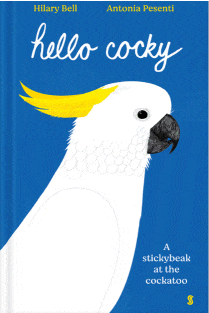
Hello Cocky: A stickybeak at the cockatoo

Hello Cocky:

Hello Cocky:


Hello Cocky

A stickybeak at the cockatoo

Hilary Bell

Antonia Pesenti

Scribble, 2025

36pp., hbk., RRP $A27.99

9781761381577

Whether white, pink, grey or black with spots, crested or bare, the cockatoo is one of Australia’s most iconic bird species that tourists love and farmers hate. 

With 14 different species indigenous to the continent, there would be few children who are not familiar with their raucous squawk, curved beaks and crazy antics, and in this new release, young readers are introduced to those and other characteristics through clever rhyme and bold artwork.

Who rules the skies from back garden to bush,
Launching from trees with a screech and a whoosh?
Bossy and smart, loves to put on a show,
Who could it be now? Why, Cocky — hello!

Focusing predominantly on the common sulphur -crested white cockatoo, this is non fiction that is informative and engaging beginning by putting the reader inside the cocky’s nest in a tree hollow and the cocky returning to find them there.  Even the title is intriguing as it echoes the most common phrase these birds learn  if they are held in captivity and ‘trained” – yet once you learn just how intelligent they are – from opening garbage bins to get to the delights inside to predicting incoming rain –  you wonder why anyone would want to cage them and deny them their right to fly free. 

Even though both rural and suburban gardens have a plethora of birdlife, both indigenous and introduced, the cockatoo is often the one that our littlies recognise first and so this is the ideal way to help them learn a bit more about them and realise that there is much more happening in that “bird brain” than they realise, garnering both awareness and respect.  There’s new vocabulary to learn “their mullet turns into a fabulous quiff” and plenty of facts to share the next time one,-often two because they mate for life – lands nearby.  

Fascinating. 

Cockatoos that feel the beat perform 30 distinct dance moves, study shows

This Bird – Noticing Our Urban Birds

This Bird

This Bird


This Bird – Noticing Our Urban Birds

Astred Hicks with Holly Parsons

CSIRO Publishing, 2025

64pp., hbk., RRP $A32.99

9781486318452 

Look out the window, stand in the backyard, play in the park – you don’t need to go far to see intriguing birds. Whether it’s the tiny fairy wren that only changes into its striking blue suit when the male is ready to mate, the comb-crested jacana that  can walk on water, or the peregrine falcon that nests on the ledges of city buildings making it the star of live-stream, our skies are alive with birds each with its unique habitat and habits. 

Identified by catchy captions, such as This bird is a tiny explorer and This bird is loud,  this new release from CSIRO Publishing features fun facts about some remarkable Australian native birds and hints on where (and how) to find them! Beginning with some general information about birds, each double page spread features a particular species with colourful illustrations interspersed with interesting information aimed at the independent reader who wants to know a little bit more than just their names.   Each page features an ‘eye’ symbol that offers a physical description, while a “binoculars’ symbol and a map show the distribution of the species  A glossary offers explanations of unfamiliar words, and each species featured is included in an index so regardless of the heading, it is easy to find the specific bird you are looking for,  In fact, that in itself could become a teaching point because the list of contents is vague – for example, “This bird is cheeky” reveals itself as the common galah. 

Written in partnership with a bird scientist, it offers authoritative information that celebrates those birds that we see so often we take them for granted, celebrating their diversity while encouraging readers to think about why they look like they do, eat what they eat and so forth and the role their environment plays on these factors.  

As well as being an invitation to be more aware of the birds we see and hear around us, this book would also be most useful in helping young citizen scientists who might be involved in projects like the annual Aussie Bird Count. However it also lends itself to investigating which species have been introduced since European settlement, and which were known to First Nations  peoples- perhaps even compiling a dictionary of their names for them, similar to the dual vocabulary commonly used in New Zealand

Another quality release from CSIRO Publishing that inspires curiosity and encourages exploration of the world around us.


Australian Backyard Birds

Australian Backyard Birds

Australian Backyard Birds


Australian Backyard Birds

Myke Mollard

Woodslane Press, 2023

64pp., hbk., RRP $A24.99

9781922800237

I have been duped!  As I look out my window and see a dozen little brown fairy wrens pecking amongst the dry winter grass for morsels, I thought that some male was going to have a great choice for a harem because I’d learned that that’s what they have – although said male was nowhere in sight.  But I may have been mistaken because  I have just discovered that most of the year, the males look like females in their nondescript brown plumage  and only change into their stunning bright blue dress when they are ready to breed!  Given it’s been such a cold mountain winter this year, that time is obviously not yet.  And all those that I thought were females, might have disguised identities.  

And that information is just on the title page of this amazing book – along with the author’s own observation of how he watch a pair trick a metre-long tiger snake up a tree -so I was eager to discover what other secrets might lie within.  Mollard himself is an avid birdwatcher – aka a “twitcher” to some – and in this stunning release, his focus is not the spectacular birds of prey or those that roam the rural and remote regions of our country,  but those that frequent city backyards – the “adaptive, resourceful and ingenious creatures [that} have not only become used to humans and human environments, but are positively thriving…[using] our buildings to rest and roost, [foraging] for grubs and worms, spiders and insects in our veggie patches, [bathing] in our water buckets, gutters, fishponds and birdbaths”.  

Unsurprisingly, in a land as vast and diverse as Australia, even though the big cities might look the same, there are different climates, vegetation, landscapes and landshapes that determine what non-human life dwells there so the book is organised according to states and territories with catchy titles like “Common Street Thugs” offering intriguing information alongside Mollard’s distinctive detailed illustrations.  With so much interest in Satin Bowerbirds since Aura Parker’s Bowerbird Blues was the NSS title for 2024 (and sequels Bowerbird Brood and Bowerbird Bloom)  it was fascinating to discover that these are not unusual in shady Canberra gardens –  perhaps in more established, affluent suburbs than those I lived in – although many of those identified in the “parliament of birds” illustration are very familiar.  With over 150 species that are commonly found in local parks and gardens across the nation, there are bound to be some that students will recognise and be eager to find out more.  Teaching notes will help guide their investigations, as well as encourage them to probe further including discussing Einstein’s belief that ‘Our task must be to free ourselves by widening our circle of compassion to embrace all living creatures and the whole of nature in its beauty’ by identifying what the threats to local populations are and what can be done to help species and attract them to the urban environment. 

With endpapers that identify the various regions, migratory paths, and other significant material, this is yet another of Mollard’s masterpieces that have intrigued me with their attention to detail that is so accessible to its intended audience of younger, independent readers who have an interest that has the potential to be more.  

A CBCA Notable for the Eve Pownall Award in 2024, this book may well be in your collection, but perhaps it is time to be the central focus for the upcoming annual Aussie Bird Count or any other citizen science project happening in your location.  


The Great Dawn Choir

The Great Dawn Choir

The Great Dawn Choir


The Great Dawn Choir

Sarah Speedie

Cindy Lane

CSIRO Publishing, 2025

32pp., hbk., RRP $A26.99

9781486318339 

Some people wake to the sound of the alarm clock.  Some people wake to the sound of their phone chirping at them.  Some people wake to the sound of sirens as early morning traffic builds up.  Some people wake to the sound of the neighbour’s rooster greeting the sun’s first rays.  And some people, like me. wake to the sound of the great dawn choir as the local birds join together to sing the new day in.  

Each day the Great Dawn Choir greets the morning sun.
Together in the growing light, their voices join as one.

For some, that early morning chorus is of the city songbirds, but for the lucky ones, like me, it is the music of magpies, currawongs, kookaburras, rosellas and even the little fairy wrens add their voices – although rather than a choir it becomes a cacophony if the cockatoos and galahs join in.  And if I go down the hill and into town there is such a raucous racket from the crows and corellas you can’t hear yourself think! 

With the exception of the lyrebird, this beautifully illustrated book could have been created at my house high in the NSW Snowy Mountains, as we are blessed to have all those species visit – indeed, even in the depths of winter many are outside my window right now as they come down from the high country as snow covers their feed.  Beginning with beautiful endpapers that feature feathers from various species, readers are treated to an array of Australian natives as beautiful as their song, many of which like the magpie and cocky, will be familiar to even the young city child and who doesn’t want to join in the laughter when the kookaburra sees something to tickle his fancy? 

But, regardless of who is making the “music”, why do they do it at that particular time? What is the reason for their calling? And why does birdsong seem to be less during the day? Why do I hear a different choir to those who live just 120 kilometres away in the national capital or on the coast? Why does Australia’s dawn chorus sound different to that in New Zealand or Nepal?  These are all answered in the information page at the conclusion of the book, along with vignettes of each of the species mentioned in the text which , with its rhyme and repetition, skips along like birdsong itself.  

As well as being the most wonderful introduction to some of our native species, this is also a wonderful opportunity to develop children’s listening skills as they learn the different sounds that different birds make – perhaps they are even ready to learn about onomatopoeia – but also begin to distinguish different breeds by their call, identifying those that frequent the school grounds and seeking ways to encourage them to stay. That might even lead into participation in the annual Aussie Bird Count in October!  And there are teachers’ notes for those who want to delve deeper.  

Another brilliant publication for young readers wanting to discover more about their world, particularly that in their own neighbourhood.  


The Enchantment of Golden Eagle

The Enchantment of Golden Eagle

The Enchantment of Golden Eagle


The Enchantment of Golden Eagle

Margaret Wild

Stephen Michael King

A & U Children’s, 2025

32pp., hbk., RRP $A24.99

9781761181078

When Ella and her little brother Leif find a fledgling golden eagle with a broken wind, they gather it up and take it home so they can help their father nurse it back to health. In time, the eagle is fit to fly free again, so big and powerful that the wolves in the forest did not dare to venture close to the house, but because of the bonds he has formed with the children he chooses to stay close by and protect them…. until the day their father has to leave them alone for a short time.

The eagle promises to stay to look after the children but the sky is calling and he is unable to resist.  But while he is soaring, diving, circling and soaring again the wolves come, and even though he saves the children Ella is very angry and curses him, condemning him to fly without stopping for a year and a day….

This is a compelling story that will have the reader turning the pages to the end so they can discover whether the eagle, seen by many cultures as a symbol of strength and freedom, survives the curse, whether it returns and what happens next.

Margaret Wild is one of Australia’s enduring master storytellers and this new release is no exception.  I love that this is such a stand-alone story that has no overt, in0your0face preachy message which seems to be the hallmark of so many stories for our young readers these days.  Yes, there can be discussions about befriending wild creatures and whether they should be kept in captivity against Mother Nature’s intentions, but it is a subtle aside that does not dominate.  Young readers can just enjoy this original story so delicately and cleverly illustrated by Stephen Michael King and be taken to a different time and place reminiscent of age-old fairy tales. Just the title alone suggests that this will be an ageless story, to be read for its magic, and indeed it is. 


The Last Egg

The Last Egg

The Last Egg


The Last Egg

Sofie Laguna

Jess Racklyeft

A & U Children’s, 2025

32pp., hbk., RRP $A24.99

9781761180330

Mother Bird sat over her eggs.
‘Not long now,’ she said to Father Bird.
Father Bird brought her worms and seeds.
‘Not long at all.’

But that night there is a strange commotion above the tree, and in the morning a fourth egg, larger than the others, is in the nest.  Mother Bird takes it under her wing with her own and as her own, and even though her little ones hatch, become independent, even flying away to warmer shores, she remains sitting on it waiting for it to hatch.  Deep into winter she sits and waits, steadfast in her determination. with Father Bird taking care of her until food is scarce and the cold becomes overwhelming.  Will Mother Bird’s belief that “all eggs hatch” mean that she and Father Bird will make the ultimate sacrifice or will there be a miracle?

This is a soft, emotional story that is built on the beliefs and values of commitment, loyalty, resilience and most of all, hope.  Even when the days seem darkest, Mother Bird believes there is better to come, even if it means risking her life to see her duty through. And when the egg finally hatches and what emerges is a surprise, she accepts it regardless.  Because that’s what mothers do – they take in strays and treat them as their own regardless of their appearance and circumstance.  We’ve all met them in our lives – strangers helping strangers because they’re vulnerable and need a hand up, not just a hand out. 

Accompanied by the soft-line, soft-palette illustrations of Jess Racklyeft that deftly show the passing of time as well as the relationships and the emotions they evoke,  Sofie Laguna has created another comforting story of  unselfishness, kindness and determination that ensures we can all believe in and reach warmer shores. 

Bob and Dob

Bob and Dob

Bob and Dob


Bob and Dob

Sean E. Avery

Walker Books, 2025

32pp., hbk., RRP $A25.99

9781760658113

There was once a small bird called Bob who had a brother, aptly called Dob because that’s what he did.  Whenever Bob did something risky like flying too high or go hunting for worms on his own, Dob would tell on him.  So often, that even their mother got sick of hearing the stories and told them she didn’t want to hear any more tales.  

Knowing he wouldn’t get into trouble, Bob got bolder and bolder until one day… 

Dob saw the danger lurking but neither Bob or his mother would listen.  And disaster strikes. Even though he was always getting him into trouble, Dob still loved Bob so can he save him?  Is there ever an okay time to tell a lie?

Although Sean Avery writes for a variety of audiences and in a variety of formats, he seems to have a special knack for crafting stories that particularly capture the attention of our youngest readers, and this one is no different.  Every little person with a sibling will know this scenario and relate to it, whether they are a Bob or a Dob.  And both perspectives are going to generate some lively discussions.

This is definitely next Friday’s read for the local preschoolers. 

Myke Mollard’s Birds of Prey

Myke Mollard's Birds of Prey

Myke Mollard’s Birds of Prey


Myke Mollard’s Birds of Prey

Myke Mollard

Woodslane Press, 2025

64pp., hbk., RRP $A24.99

9781922800589

It never ceases to amaze me that young lads, particularly, are able to identify and name the various types of dinosaurs, some of which have names nearly as big as they are.  And it is the same with birds of prey.  There is a certain fascination with these raptors which mean they can look into the sky and know whether it’s a hawk or a wedge-tail eagle circling, or they can look at a picture and tell you just which type of raptor they are looking at…

And so, this new release from the amazing Myke Mollard who has a passion ” to educate kids about the natural world”, is going to be so well-received by anyone with an interest in any or all of the 500+ species  of birds of prey whether they are falcons, harriers, hawks, buzzards, kites, owls, eagles or vultures.

While, in general, we think of such birds as those that catch and consume smaller creatures as their main food source, it is the ability to use their keen eyesight, smell and hearing to locate their prey and then using their speed to seize it with their feet to tear apart with their hooked beak that sets them apart from other carnivorous birds that primarily use their beak to attack, such as the kookaburra.

Spanning time -the ancestors of  such birds reach back 50 to 78 million years – as well as geography  -they exist on all continents except Antarctica – young and not-so readers will be fascinated by the range of information and illustrations that are covered generally arranged by the scientific family they belong to. Most intriguing for me was to discover that there was an eagle that was able to attack the mighty moa, a long-extinct bird of New Zealand that we were always taught was the mightiest in the forest. (And all that was from just reading the first page, which then inspired me to read even further.)

When it comes to investigating Australia’s natural history, Mollard is a worthy, relevant and reliable go-to source because of his unique ability to write at a kid’s level (and be aware of the intended audience of the work)  while offering such incredible illustrations that beg to be explored beyond the pages. And, as usual, the endpages offer so much more information.  It is no secret now that I am a fan of his work, and look forward to reviewing his new works because I know that I will always learn much that is new and which will send me down rabbit-holes of discovery.  As you can see, this one did not disappoint!!  

One to get your independent readers with an interest in the topic immersed in it asap. You may even attract some of those reluctant readers. 


Tawny Trouble

Tawny Trouble

Tawny Trouble


Tawny Trouble

Deb Fitzpatrick

Fremantle Press, 2025

128pp.,. pbk., RRP $A14.99

9781760995294

Tessa and her family have been to a weekend music festival and are returning to their holiday cottage in an old logging village deep in the south-western WA forests when they hit a tawny frogmouth diving for the insects attracted to their car’s headlights.  Luckily, Tessa’s mum was driving slowly because not only is nighttime wildlife on the road a novelty for them, but Tessa and her young brother and sister have heard stories of the possibility that there could still be thylacines in the area, because before the last-known one died in Hobart Zoo in 1936, and they were officially declared extinct in 1982 by the International Union for Conservation of Nature (IUCN) and in 1986 by the Tasmanian government, the creature roamed the Australian mainland, not just Tasmania, and their eyes were looking at every movement and shadow.

Although the tawny frogmouth is not killed, it is injured and so the family put it in a box and first thing the next morning, they seek help for it.  Directed by Sharon the village shopkeeper, they meet Otto, a local wildlife carer who lives off-grid deep in the forest who takes Tawny and puts her in a vast aviary to heal, while introducing the family to some of the other creatures in his care,

This is a fascinating stepping stone story for young emerging readers who will not only put themselves in Tessa’s shoes but also learn about how to care for injured wild animals, becoming more and more common on roads, including that you must turn it into a registered carer within 72 hours. They will feel her fear as she makes her nighttime journey through the bush when she has her “big bad idea” and heave a sigh of relief when the resolution is revealed.  

Not only an engaging and satisfying read in itself, because the mystery of the thylacine is unresolved, and the family book into the same cottage for the next school holidays, it may be that there is a sequel coming… 

In the meantime, readers can enjoy Kelpie Chaos by the same author.

Original photographer unknown

Original photographer unknown