Archive | April 2026

A Better Best Friend

A Better Best Friend

A Better Best Friend


A Better Best Friend

Olivier Tallec & Antony Shugaar (translator)

Gecko Press, 2026

32pp., pbk., RRP $A17.99

9781776575749

All Squirrel wants is a friend and the day he was out walking in the forest and met Pock the Mushroom, he not only found one but Pock became his best friend. Usually he only found pinecones but everyone knows that best friends don’t fall from trees like pinecones.  They enjoyed exploring the forest as the seasons changed, and there were new things to show each other and do together.

But when Spring came, Moo Mosquito joined them and before long, was showing them new places and things to do, like eating blackberries and skipping stones across the water.  And then they were joined by Gunther…  Squirrel wanted just one best friend and now there are three….

This is a deceptively simple story with minimal text that tells of Squirrel’s quest for a friend, accompanied by stunning illustrations that carry it along perfectly.  But it sets up a question that is going to encourage young readers to delve deeper into the meaning of friendship and all its ramifications – can you have more than one best friend?  If best friends are those with whom you share your deepest thinking and are there for you no matter what, making even the bad time not-so-bad, is there room in your life for more than one? Do you exclude someone new because you already have your one best friend? How does that make the newcomer feel?

As little ones spread their wings and explore the world beyond family, there is a lot to learn about how to be a good friend, and there are endless books and lessons devoted to this, but A Better Best Friend takes those a step further.  What is a best friend? What qualities do they have that makes us want to be and share with them that we hold back from others? Can we have more than one? Is one BFF better than the other? Or do different friends fulfil different needs in our lives?  Can the intensity of friendships ebb and flow, perhaps even disappear over time? What happens when the person we consider our best friend wants to play with someone else? What could happen if Puck and Gunther wanted to have a card game just for two? Is that okay?  How would Squirrel feel? Are our friends “allowed” to have other friends?  

Just like Squirrel’s dilemma, the answers are open-ended and like the final picture in the story, the reader has to draw their own conclusions.  There may not even be a definitive answer, but reflecting on the possibilities can only prepare them for those inevitable changes that are going to happen, because just as the seasons change and bring new opportunities throughout the story, so do life’s circumstances and situations.

Any story that helps our children understand the world better, particularly those things they are likely to encounter, and develop strategies to deal with them so they navigate them with as little stress as possible, has a place in the mindfulness curriculum and this one, with its appealing characters should definitely be there.

The Magic Faraway Tree

The Magic Faraway Tree

The Magic Faraway Tree


The Magic Faraway Tree: The Story of the Film

Enid Blyton

Hodder Children’s,  2026

212pp., pbk., RRP $A16.99

9781444952247

Nearly 90 years ago, as war clouds gathered over Europe and the world was swept up into a global conflict not seen since, English author Enid Blyton wrote the first in a new series of books that focused on a huge tree in the middle of a secret forest, a tree that housed characters with names like Moonface, Mr Watzisname, Angry Pixie, Dame Washalot and a fairy called Silky. It had a slide down its centre and a ladder that led to the clouds at the top where every now and then, a new land would arrive to offer its visitors extraordinary adventures.  Both the wood, known locally as The Enchanted Wood, and the tree are discovered by three children – Jo, Bessie and Fanny –  when they chase a gnome who has robbed some elves of some important papers, following him up the tree where they encounter its strange inhabitants and, over time, learn its secrets…

It was just the kind of escapism that young British children needed as many were separated from their parents through forced evacuation to the country or worse, and was followed by  The Magic Faraway Tree (1943), The Folk of the Faraway Tree (1946) and Up the Faraway Tree (1951). Despite later being criticised by adults wearing their modern politically-correct hats as being “racist, xenophobic and sexist” and even sanitised in more recent editions to supposedly appeal to a more modern audience, the magic and wonder of both Blyton’s imagination and the tree itself have endured as it is now a fabulous movie that has become a family must-see and the childhood audience for whom it was intended have had the last laugh, as they take their own children and grandchildren to see it.

Now, to continue the magic and the wonder long after the final credits have rolled, there is this wonderful novelisation that young readers can return to again and again – a story that starts with a note to the reader from the director of the movie and begins… “We are so excited for you to read this book,  I think books are better than films because while we needed hundreds of people to make all the moving pictures for the Magic Faraway Tree film, you just need your amazing brain and imagination to see the tree and the lands in your mind when you are reading…”

Isn’t that the best intro to a book that you have read in a long time? It just sums up so much about the power of books, stories and reading so well, and what fascinated me was that despite the series being my all-time favourite for decades – I don’t know how many hundreds of children I’ve shared it with over the last 55 years of teaching – as I read, my imagination was just as carried away as it was back in the early 50s when my mum gave it to me, and there were new images and wonder that appeared on the screen of my mind. I was as engrossed today as I was then, and admit to binge-reading it well past my bedtime.  Familiar and new characters and lands marched through my dreams all night!

The beginning of the story itself has been brought into the 21st century – Beth, Joe and Fran are mainly cared for by their stay-at-home dad and spend their waking hours glued to their screens but when their mum loses her big city job, the whole family moves to a ramshackle barn on the edge of a wood. It’s bad enough that they’ve had to downsize, but now their phones have no signal and they actually have to interact with nature! However, the rest of the story is pretty much the same.  Fran finds a little purse and returns it, and from that good deed, just as that of her predecessors, the adventures begin…  And, as with the original, while the adventures are pure fantasy, there are subtle lessons to absorb as the children learn not just about themselves and their relationships, but the whole family begins to reconnect and appreciate each other again.  And, of course, it concludes with the possibility of a sequel.

But while the reader waits for that, they may well go in search of the original adventures -perhaps looking on Grandma’s bottom shelf – and starting new conversations and connections that way, as well as seeking out other new adaptations like  A New Adventure, , A Christmas Adventure, and the stories of Silky and Moonface , each adding to a series that has enchanted readers for generations gone and to come.

This one is definitely finding a permanent home with its parents on that special bottom shelf!

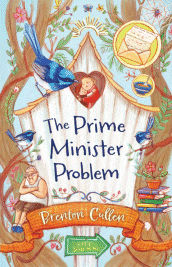
The Prime Minister Problem

The Prime Minister Problem

The Prime Minister Problem


The Prime Minister Problem

Brenton Cullen

Riveted Press, 2026

192pp.,  pbk., RRP $A17.99

 9781764256728

So many of us know Wren – the quiet, shy, introverted child who seeks solace in the library because it’s safer than the playground; the child who reads the Guinness Book of Records so they can say something but is never asked to contribute; the child who is always the last to be picked when it comes to team tasks; the child whose mum loves him dearly but is so busy working two jobs to make ends meet she never has time; the child who desperately wants a friend but whose only friend is his grandmother with whom he shares a love of nature and birdwatching… The invisible child who begins to think he is unworthy of attention, let alone love.

But then his teacher Miss Peg tells them that the term’s focus will be the government and particularly the prime minister, their roles and responsibilities and the class will work in teams to present a speech. Could being teamed with Tamara, the kid new to the school and the town, be a turning point for Wren? No- it seems not for she quickly sizes up the atmosphere and joins the hurt-you-before-you-hurt-me in-crowd who relentlessly tease Wren, before they discover her vulnerabilities.  But Wren is used to disappointment and goes it alone, again, convinced that if the PM’s job is to help everyone, surely she will help him save the animals from the current bushfires. So he writes to her and then waits and waits and waits for a reply…

However, while he is waiting a bigger, more personal problem arises – his beloved Grandma has a stroke and is going to need full-time care.  Problem is, there is no full-time care available in his small rural town and she is going to have to go to a nursing home in  the city three hours away where she knows no one and visiting is going to be hard.  Surely that is a problem that the prime minister would respond to – but another letter to her goes unanswered and even an attempt to travel to Canberra is thwarted.

And then Wren has an idea – one so big and important that from deep within he finds the courage to put himself in the spotlight, overcome his fear of speaking to groups, . An idea that finally gets the PM’s attention, but by them it doesn’t matter because his thinking has gone viral and the whole country is behind him already…

This is a powerful, read-beyond-lights-out story that is going to resonate with so many readers whether they see themselves as Wren, Tamara, or one of their school’s in-crowd, or even know Grandma or Mr Bright. In a digitally connected society that has never been more disconnected, loneliness is rife particularly as families and friends are so scattered, yet is masked by that prevalent unwillingness to show our deepest fears and feelings, in case we be judged in a world that thrives on likes and the approval of others. 

Few viewers who watched it will forget the warmth, charm and life-changing events of Old People’s Home for 4 Year Olds. and this is a story in the same vein for younger independent readers. Cullen has touched a hidden nerve, one that the Prime Minister can’t fix, but which one child’s hope, love, courage and determination does, and which may even spark a similar solution in the reader’s realm. One child can spark change and while helping others, help themselves too – not just growing a friendship group, but self-confidence and self-worth too.

Cullen has crafted an authentic novel that not only reflects real life but also addresses the “Now I know this, what next?” issue. At a time when every problem is blamed on the Government and therefore should be fixed by them, Wren (and the reader) learn that often the greatest solutions come from within those most affected.

The Brilliant Brain Club

The Brilliant Brain Club

The Brilliant Brain Club


The Brilliant Brain Club

Lucas Ocean Gallagher

Hembury Books, 2026

60pp., pbk.

9781923517882

Not so long ago Lucas Ocean Gallagher was one of those never-sit-still, always-talking kids that teachers dreaded and friends avoided because they always seemed to be in trouble, disrupting everyone’s learning and generally causing chaos in the classroom. Teachers viewed them as naughty and peers avoided them wary of being in trouble by association. They were the ones that were the subject of many a staffroom debrief as the class teacher sank into a chair, exhausted. 

And then in the 1990s some enlightened principals (like mine) learned about the work of people like Eric Jensen, Robert Sylwester, Renate and Geoffrey Caine, Marian Diamond,  and several others who were building on the works of Piaget, John Holt, and Edward de Bono, and exploring and explaining not just how people learn, but how children, in particular, do so and from their research we, as teachers and parents,  began to get an inkling of how some brains are wired differently, how some kids think in totally different ways, how their “disruptive’ behaviour was innate not a choice and, while the term “neurodiversity” did not enter our vocabulary for a while, at least we were more aware of the ‘why’, more tolerant of the ‘what’ and learning to develop strategies so we could deal with the ‘how’.

Although there are many, including teachers, who still view neurodivergence as a choice and conditions such as ADHD as being “naughty”, “attention-seeking” and “disruptive” that can be cured through strong disciplinary measures and punishment, advances are being made, particularly as it is estimated that about 5% of our children suffer from the disorder.  

The author of this book is one of those kids. Lucas Ocean Gallagher is 10 years old, lives on the Gold Coast, is passionate about the ocean and its conservation, and he wrote the book with his mum because they wanted “to talk about the positives of being neurodivergent” so that others “don’t think there is anything wrong with them because they learn differently” and so they “feel less alone.” Told by Lucas himself who managed the early years of school because there was plenty of movement and activity but who began to struggle in Year 2 because of having to sit still for long periods, write a lot even though it hurt his hand, concentrate on what his teacher is saying even though is mind is elsewhere – usually surfing – and who needed perfection but never had enough time to produce it,  It is the story of his journey from being the naughty, continually restless kid to understanding and accepting that his ‘different’ brain is actually a superpower and that there are lots of other kids like him who belong to The Brilliant Brain Club, led by a teacher who “got” him and a mother who was also diagnosed with the condition as an adult.

Because it is told by Lucas, the reader, whether adult or child, gets an insight into what it’s like to be the one who is different, who feels friendless and isolated, and the impact of finally learning how their brain works and that who they are, as they are, is not just OK but something to celebrate.

When my principal (vale Helyn Strokowsky) introduced the staff to the ‘Learning to Learn’ pedagogy that focused on how children learned and how we, as teachers, could best build on that, it was the fourth light bulb moment for me as a professional – the other three were that teaching little ones was where I belonged, teaching literacy was my go-to and being a teacher librarian was my calling – and to this day I am unable to part with the shelves of professional texts that I continually refer to. And, as a reviewer of children’s  books, I have been privileged to read more than most about how thinking differently impacts the child’s life so that what I have learned through those books now shapes my relationships with others.  Lucas’s story has added to that knowledge and understanding, particularly because his story is not fiction written through the eyes of an adult, and for that alone, it is a must-read for every teacher and a must-share with every class.  Let’s continue Lucas’s legacy of embracing everyone regardless of how they learn and including rather than excluding them.


Skipping to Sammy’s Beat

Skipping to Sammy's Beat

Skipping to Sammy’s Beat


Skipping to Sammy’s Beat

Coral Vass

Blithe Fielden

New Frontier, 2026

32pp., hbk., RRP $A26.99

9781923331020

The year Sammy turned four she wore her pink tutu, her spotty yellow gumboots, her big bat wings and her bike helmet.

That year she splashed in puddles, dangled from trees, looked for ladybirds and danced down the path to the beat only she could hear… tap, da–dum, tap. tap. ta-dum. But things changed when Sammy turned five as she started to notice her friends dressing more conservatively and laughing at her dancing – so much so that the beat grew quieter and quieter until she no longer heard it, and no longer danced.  She just watched her friends do those things that had once given her pleasure, getting sadder and sadder… Until the day as she slumped near a large puddle and saw a dragonfly desperately trying to escape the water’s clutches.

A peek inside...

A peek inside…

Sammy’s story could be that of so many children who are content and comfortable in their own skin being just who they are, until the perceptions and opinions of the outside world begin to creep in. Suddenly, they start to compare themselves to those around them,  it matters what others think of them, and conformity is easier than the conflict that being different can engender. At least, on the outside, because on the inside a battle can be raging , But through this sensitive story with its vibrant but gentle artwork, young children can learn that it is okay to hear a beat in your head and move to it in your own way, even if you are the only one who can hear it. It takes courage and confidence but the rewards are worth it.

With so many little ones feeling the first seeds of self-doubt and anxiety as they begin their journey into a world wider than the family home, they need to hear and talk about stories like Sammy’s so they have the affirmation that who they are, with all their quirks and foibles is enough, is perfectly okay, and to be celebrated so they can conquer the fears and insecurities before they take hold or worse, take over.  They need to know that dancing to the beat of their own drum is the best path to take.

The Man From Snowy River

The Man From Snowy River

The Man From Snowy River


The Man From Snowy River

Banjo Paterson

Cate James

Penguin, 2026

24pp., board book, RRP $A14.99

9781761355110

There was movement at the station, for the word had passed around
That the colt from Old Regret had got away,
And had joined the wild bush horses –  he was worth a thousand pound,
So all the cracks had gathered to the fray.
All the tried and noted riders from the stations near and far
Had mustered at the homestead overnight,
For the bushmen love hard riding where the wild bush horses are,
And the stock-horse snuffs the battle with delight.

There would be few who have gone through the Australian education system who can not recognise, if not recite, these first lines from Banjo Paterson’s iconic poem, the legends it has sparked, and, indeed, the controversy of the continued presence of the brumbies in the high country that divides some communities.  Its story, its heritage and its carefully chosen words so deftly woven into an unforgettable rhythm that echoes the horses’ hoofbeats are part of the nation’s DNA, as well as having all the elements that make for ideal reading for little people. So why not introduce it to our youngest readers?

Carefully edited by Kathryn England, selected lines from the saga have been extracted and melded into telling the basics of the story, each key “episode” carrying the little one along on a fast pace adventure, with bold illustrations encapsulating the action so even if the words are not quite understood yet, they can still work out exactly what’s going on.  And because England has chosen to use Paterson’s words rather than paraphrase them, there are opportunities for the adult to help the child work out the meaning of some of the unfamiliar terms, thus encouraging them to use the pictures for the clues, as well as extending their own vocabulary. 

What do you think a "colt' is?

What do you think a “colt’ is?

But even if they’re not quite ready for that, each double-page spread with its text on one side (in the same colour as the focus objects) and picture on the other, becomes a counting and colour recognition exercise, again developing the child’s perception skills as they search for “5 green grasshoppers” or “9 white snowgums”, extending their word knowledge and building an awareness of a landscape probably very different to the one they are familiar with. 

Along with Waltzing Matilda, this is the first in what is hopefully an extensive series of Australian Classics for Little Ones that will introduce our youngest readers to the rich heritage of our history through literature that is uniquely Australian,  celebrating our way of life, our beliefs and values and the culture they have been built on through generations. 

For those who are a little bit older, there is The Colt from Old Regret which sheds a different light, and for those who love an earworm…


Guess How Much I Love You: Out and About in 100 Words

Guess How Much I Love You: Out and About in 100 Words

Guess How Much I Love You: Out and About in 100 Words


Guess How Much I Love You: Out and About in 100 Words

Anita Jeram

Walker Books, 2026

16pp., hbk., RRP $A19.99

9781529526912

Few little people would go for very long without meeting Little Nutbrown Hare and Big Nutbrown Hare in Sam McBratney’s classic, Guess How Much I Love You.  And while McBratney sadly passed in 2020, Anita Jeram, the illustrator of those indelible images has created a new book that is the perfect accompaniment.

In it, Little Nutbrown Hare and Big Nutbrown Hare go on a walk together and, as they meander from the pond to the mountain, and from the meadow to forest they explore the world around them and the things that inhabit it.  Each new landscape has its own double-page spread and vignettes identify the items and their labels of those things that belong there.

A peek inside...

A peek inside…

Learning to communicate through speech and language is an instinctive human development and we naturally focus on those things that are familiar to us within our surroundings.  But extending the child’s vocabulary to encompass the words that are not within their immediate realm is essential, particularly if children are to be successful readers, and there are many academic reports to support this including this formal part of the NSW English syllabus. and the accompanying video.  But the earlier we start to build a child’s vocabulary the better, and so books and stories like this  play a vital role in extending their knowledge as they learn about worlds beyond their own and to search the pictures for clues to aid their understanding and provide context for their predictions..  If the story is about the seaside, they are more likely to suggest sand rather than snow. Later, as they start to learn initial sounds, they can refine their predictions for unknown words by getting their mouths ready to say what they see that begins with that extra cue.  

Thus, this little book that will survive little hands going to it time and again, is an ideal addition to the new baby’s library as well as the preschooler’s because they can use it over and over to make up their own stories using familiar characters, the settings, the words, their existing knowledge and, of course, their imaginations. Or maybe they could create an extra page to teach , Little Nutbrown Hare and Big Nutbrown Hare about what they might see if they came to the child’s backyard.  (Right now, if they came to mine they would see kangaroos, a couple of magpies, including mother and daughter, squabbling with the currawongs, some crimson rosellas waiting for the spoils of the squabble,and the bark peeling off the snowgums in long ribbons – probably very different to what is outside their window.)   What more could you ask for?


Casey Keys and her Powerful Sneeze!

Casey Keys and her Powerful Sneeze!

Casey Keys and her Powerful Sneeze!


Casey Keys and her Powerful Sneeze!

Meg Riley

Garth Cochrane

Little Steps, 2026

32pp., hbk., RRP $A24.99

9781923141575

Poor Casey Keys has allergies

that itch her nose and make her sneeze.

All the common causes are there – green grass, seeds, cats, bubble baths, feathers, pepper, flowers – but no matter how hard she tries to hold the sneeze in, she just can’t.  And when Casey Keys sneezes it blows everything away and causes complete chaos!

She feels her only solution is to run away to sea and let her sneezes carry her and her sailboat across the oceans.  But it’s lonely out there so could there be another remedy?

There will be many young readers who will empathise with Casey as they relate to her distress, although hopefully none causes quite the bedlam that she does, and so they will enjoy both the story with its clever rhyming pattern that carries it along and the energetic illustrations that capture both the physical and emotional consequences of her affliction so perfectly.

A fluffy cat... is worse than that!

A fluffy cat… is worse than that!

However, while Casey’s sneezes cause chaos, their cause is not catchy.  Nevertheless, her predicament could start a conversation about basic sneezing hygiene, like sneezing into your elbow, using a handkerchief or a tissue, washing your hands and all those other things we learned during the pandemic to protect ourselves and others, particularly as flu season approaches. It’s the perfect story for this time of the year.


Protecting the Planet: Creatures of the Coral Reef

Protecting the Planet: Creatures of the Coral Reef

Protecting the Planet: Creatures of the Coral Reef


Protecting the Planet: Creatures of the Coral Reef

Martin Jenkins

Jason Cockcroft

Walker Books, 2026

32pp., pbk., RRP $A16.99

9781529516289

Imagine you’re a butterflyfish. Where do you live? It’s a place that’s warm all year round, not too deep and full of life: it’s a coral reef!

If you live or visit Australia’s coast, one of the longest in the world, chances are it is protected by a reef whether it’s the Great Barrier Reef, the world’s largest coral reef system, the Great Southern Reef a fringe of interconnected underwater systems that span 8000km from the NSW/Queensland border, around Tasmania and its islands, along our great southern coastline and up to Kalbarri in Western Australia., Ningaloo  on the north-western coastline or any of the other systems that dot the shoreline and encircle the continent.

While each has its own ecosystem perhaps it is the colourful inhabitants of the coral reefs that first spring to mind, and in the new addition to the Protecting the Planet series which includes Ice Journey of the Polar Bear,  The Season of Giraffes, Emperor of the Ice,  and The Secret World of Seahorses, young readers are introduced to how such reefs are formed, the creatures that are dependent on their survival and how they are dealing with the challenges of climate change and other factors that threaten their survival.  They learn about the amazing biodiversity of the reef and the interdependence of each species, as well as how vulnerable each is and what even an individual can do to help it survive and thrive.

Protecting the Planet: Creatures of the Coral Reef is one of a list that Publishers Weekly have put together a list of children’s picture books that encourage children to explore the world around them and consider how to care for it to acknowledge Earth Day today, and although most on that list are US publications,  Australian authors, illustrators and publishers have produced a plethora of books on this theme, including those about the reefs that surround Australia,  it could be an opportunity for STUDENTS to search the shelves for stories that reflect their personal interest in the environment to create a library display, Apart from enhancing their skills at using the OPAC, if they are also required to read the book and write a synopsis of its central message so others can make informed choices about borrowing it then there is purpose for both the display and their reading.

On this blog alone there are over 450 titles with the Environment and Sustainability tag so there are plenty for even our youngest readers to begin to explore and think about what they can do to make a difference.  Perhaps a class might even adopt a particular project giving the whole task even greater context and purpose.


Paw Prints: Stuck in a Handstand!

Stuck in a Handstand!

Stuck in a Handstand!


Stuck in a Handstand!

Andrew Hansen

Jessica Roberts

Walker Books, 2025

64pp., pbk., RRP $A12.99

9781760658717

Pattie Cake – she knows it could have been worse – is starting a new school and she, like so many in the same situation, is worried that she might not be good at anything, or she might forget to wear pants!  Or she forgets her lunch and the principal offers her hers, but the principal’s lunch is a bowl of spiders that she is obliged to eat?

She is a classic over-thinker with all sorts of what-ifs that roll around her brain (and usually stay there) but this time this one didn’t.  It seems all the kids at Wingsville Primary are all talented in some way, and Pattie particularly admires the girls who do gymnastics.  She would love to join them but it’s not her strength  – until she is called to the principal’s office and is invited to share her deepest wish with Ms Plots’ magic fish so her time at the school is more pleasant…

What happens next is an hilarious story about being careful what you wish for and another in the Paw Prints series especially written for those young readers who can manage early novels.  Using text, fonts, formatting and illustrations and the sort of language and humour that its target audience of newly independent readers loves, the series is designed to encourage emerging readers to continue reading. While the incidents (and accidents) that the teachers and their students get involved in are pure imagination, nevertheless the characters themselves and their concerns  are very relatable and offer food for thought if they were in a similar situation. How would they feel about starting at a new school where everyone seems to have a special talent? If they had access to Ms Plots’ magic fish, what would they wish for?  What might be the unintended consequences if the wish were granted?  Could be the start of their very own story…

A peek inside...

A peek inside…