Archive | July 2025

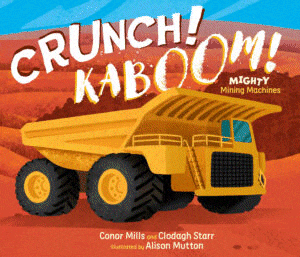
Crunch! Kaboom!

Crunch! Kaboom!

Crunch! Kaboom!


Crunch! Kaboom!

Mighty Mining Machines

Conor Mills & Clodagh Starr

Alison Mutton

Fremantle Press, 2025

40pp., hbk., RRP $A24.99

9781760995102

Outside the town, in the heat and the dust, where the sky is bright blue and the earth is like rust,

Is an iron ore mine that’s bigger than big with mighty machines that blast, drill and dig. 

While many of our young readers will be familiar with the big machines that sit the city skyline as towering new buildings and underground tunnels are constructed, and others will be familiar with all the machinery that is required to maintain the productivity of farms of various types, not so many will recognise those that are used on mining sites, particularly iron ore mines in far north-west Australia. So this is one that is going to not only satisfy the young reader who loves books about trucks and other big things, but also introduce them to a whole new range.

Bright illustrations that show how the traditionally yellow machinery contrasts so well with its surroundings so it can be easily seen, and onomatopoeia that echoes the noises that are made will engross both boys and girls as they pour over the pages and can be just as noisy as the work site.

But this is another that is not just for little readers who like big, noisy vehicles because Australia is a global leader in the production of iron ore generating billions of dollars for the national economy, and despite being largely based in WA’s Pilbara, nevertheless thousands of families from all over the country regularly bid farewell to mums and dads as they are FIFO (Fly In Fly Out) workers.  Thus it can help provide an introduction to their away-from-home lives as well as tracing the production of steel, sparking deeper investigations  perhaps beginning with identifying the everyday things around them that are made from it. Teaching notes offer further ideas.

The narrative non fiction format is opening up all sorts of worlds to younger readers in a way that traditional fact-and-figure non fiction did not, and this one  is an engaging, informative story that goes far beyond what is first anticipated by the title alone. Indeed, a search of SCIS shows only four titles relating to modern mining suitable for younger readers published in the last 10 years so it is indeed, filling a hole in both the curriculum and the collection. 


Hedgehog or Echidna?

Hedgehog or Echidna?: Animals who are the same . . . but different!

Hedgehog or Echidna?: Animals who are the same . . . but different!


Hedgehog or Echidna?

Animals who are the same . . . but different!

Ashleigh Barton

Amandine Thomas

Lothian Children’s, 2025

32pp., hbk., RRP $A24.99

9780734422682

Hedgehog and Echidna stop  in their shuffly tracks when they meet each other in the forest, surprised to meet someone who is so similar to them but really very different.  And so begins a conversation between the two as they compare their differences, not only educating themselves but also the young reader who may be familiar with both from their storybooks and perhaps in real life -although hedgehogs not only do not live here, but it is illegal to keep one- but not yet able to distinguish one from the other.

Having discovered that they, themselves, are very different despite appearance, the conversation then turns to other animals around the world that are often mistaken for each other, including crocodiles and alligators, llamas and alpacas, rabbits and hares, ostriches and emus and even eels and sea snakes.

Written in rhyme with stunning illustrations that convey the status or each animal through their facial expressions bringing them to life in the way a photograph doesn’t, this is a book that makes you wonder why it hasn’t been written before!  It has heaps of potential to spark investigations into each of the creatures – who knows how to distinguish a magpie from a raven, rook, jackdaw or crow? –  as well as looking for others that could become extra pages in the book.  For younger readers, it  also builds on those initial compare-and-contrast exercises that they engage in, demonstrating that there can be other attributes to look for beyond size, shape, colour and purpose, perhaps beginning with a comparison of similarities and differences between them and their best friend with valuable lessons about still being friends despite being different.

Having lived in New Zealand where we regularly left a dish of milk for the hedgehog who visited each night, and in Australia where we have them waddling around on their endless search for ants, and still fascinated by the experiences, a fact that I know that isn’t mentioned in the book is that hedgehogs DON’T uproot your pot plants to find a place to sleep!  


Or maybe take a wander across the snow…


Wind Atlas

Wind Atlas

Wind Atlas


Wind Atlas

Everything You Need to Know about the Wind

Sarah Zambello

Suzy Zanella

Thames & Hudson, 2025

80pp., hbk., RRP $A34.99

9781760764517

It was the East Wind that blew a magical nanny called Mary Poppins to the children who lived in Cherry Tree Lane … and the West Wind that wafted her away again, holding firmly onto her umbrella!

From a quote from Mary Poppins by Australian author P. L. Travers on the front endpage to information about the Aeolus satellite launched by the European Space Agency to measure terrestrial winds from space on the back, this is another masterful work that is going to intrigue young independent readers who are fascinated by the world around them, and, in particular the weather.

Whether it’s the gentle touch of the susurrus, the fury of a cyclone, Aesop’s argument between the North Wind and the Sun, or just having the urge to fly a kite, rarely a day goes by when the wind, or lack of it, isn’t a topic of conversation between people from their earliest days,  It affects our moods and our behaviour – teachers hate windy days more than wet ones – and so much of what we choose to do is impacted by it. 

So this companion to both the Wave Atlas  and the Cloud Atlas, produced in collaboration with the University of Genoa, is going to be a welcome addition to both home and school library as students seek answers to their questions about what the wind is, where it comes from, why it is sometimes gentle and othertimes fierce and all the other queries they have.  As well as the facts and figures including a detailed but very accessible explanation and description of the Beaufort Scale which measures the wind’s force, there are ancient legends, the impact of mountains and monsoons and all sorts of other interesting information that will enable budding meteorologists to understand this natural force better.  Just like its predecessors, it is based on meticulous research which has then been interpreted into accessible language and accompanied by clear and fascinating illustrations for its intended audience. They can even explore the story behind this image…

Does the flap of a butterfly's wings in Brazil set off a tornado in Texas?

Does the flap of a butterfly’s wings in Brazil set off a tornado in Texas?

Because it was originally an Italian publication, there is a focus on the winds of the Mediterranean region, but Australians can find out about what current events using this page from the Bureau of Meteorology, or get more specific information from Geoscience Australia

So whether it is wanting a forecast for a fishing adventure, information into an investigation into generating energy from the wind, or just wanting to know if it’s a good day for kite-flying,  this book not only has the power to answer the questions but the potential to spark so many more.

The joy of a brisk wind and a kite...

The joy of a brisk wind on a cool mountain day and a kite…


Weaving Country

Weaving Country

Weaving Country


Weaving Country

Chris Joy & Aunty Kim Wandin

Ashleigh Pugh

Walker Books, 2025

32pp., hbk., RRP $A26.99

9781760657628

When Walert (Possum) sees her Gugung (grandmother) gathering djirra (reeds) by the river, the susurrus through the rushes invites her to follow her home, little knowing that she is going to learn one of those precious lessons that generations share between each other as they pass the knowledge of their culture to each other. 

In Walert’s case, she not only learns about the physical construction of a woven binak  (basket), but also how the sun, land, water and wind all play their part in the growing and the preparation of the djirra so they are ready to weave, strengthening her understanding of her connection to Country that is so integral of First Nations culture and life.  And when a boroin (blue wren) builds its tiny nest in the drying djirra, and lays three little eggs, Walert also learns patience.  This is not the time to disturb the circle of life that has endured for so long.

This  is a story set on Wurundjeri Country in the Yarra Valley, Victoria and based on the work of author Aunty Kim Wandin who is a master weaver and Wurundjeri Woi-wurrung Elder, whose traditional basket making has been handed down to her by direct lineage, so Walert’s lessons have authenticity and authority. The teachers’ notes which accompany it specifically focus on encouraging “students to
slow down, listen deeply, and build respectful relationships with place, themselves, and each other, honouring the wisdom of intergenerational learning and the living stories carried by land and water. ” offering opportunities to engage with the land, its harvest, its inhabitants and each other that they might not otherwise consider.

But as well as connecting both Walert and the students to their natural environment, the story itself has a strong focus on the passing of knowledge, skills and understandings between Gugung and Walert making it an ideal springboard for helping young readers develop their understanding of the outcomes embedded in the early years of the Australian HASS curriculum . What stories and skills have their grandparents shared with them, such as  favourite books, or music, or crafts or how to mend a bike or….???  Is there something that their family always does at a particular commemoration or celebration because that’s the way it has always been done? For older students, what stories, traditions and skills will they pass on to their own children?

From 2027 in New South Wales, the Human Society and its Environment K−6 Syllabus (2024) requires students in Stage 1 (years 1 and 2) to understand that “People use stories, images, objects and sites to understand the ancient past” with a specific focus on the ancient cultures of China, Egypt, Greece and Rome, and those in Stage 2 (Years 3 and 4) to focus on the ancient cultures of Mesoamerica which include  the Maya, Aztecs and Incas so although their grandparents are not that old, this could be a bridge that helps them understand that much of what they know and do today is built on what those who have gone before have known and done beginning within their own family and their own experience. 

While there seems to be an upsurge in the writing and publishing of books that explore First Nations’ connections to Country, helping non-Indigenous children understand and appreciate the Welcome to Country and Acknowledgement of Country that are part of their daily lives, this one, through its story and indeed, its literal and metaphorical focus on weaving, is a stand out. 

George goes to the Farm

George goes to the Farm

George goes to the Farm


George goes to the Farm

Sinead Saint

Wild Dog Books, 2025

32pp., hbk., RRP $A24.99

9781742037011

George is a city dog. He has a busy life of lattes, trips to the salon and meeting pals in the park during the week so when the weekend comes, a country minibreak will be just what he needs.

But when his farm friends need help because one of them is sick,  will George jump up and get the job done? Or will he be the pampered pooch of his week day routines?

This is a charming rhyming story for our littlies that offers many opportunities to explore not just along the lines but between and beyond them. For starters, it helps them not only identify the days of the week but distinguish between those that are considered working and break days for many, although for the little ones I will share it with every day is a workday because they, themselves, live on farms.  Perhaps it will be a case of unpacking which are school days and which are not. 

There is also the opportunity to begin to learn to compare and contrast as they learn to look for differences that might not be so obvious as the usual attributes of shape, colour, size and so forth – for example, George having his hair done in the salon compared to the same procedure on the farm.  And while my little ones will be familiar with some of the things George has to undertake, such as gathering eggs, they might not be so familiar with city dogs gathering in the park on leads, restrained by owners carrying pooper-scoopers.  To them, body waste is part of daily life not to be stepped in so just watch where you’re going.

So, despite the anthropomorphism of George – which adds to his appeal, the humour and the plot of the book – there is still much to gain from an after-read discussion. There are teachers’ notes to assist this.

However, there is also a place to share this with older readers because it is based on the author’s own life – having grown up on a farm, she likes to retreat there for weekends with George, her ageing groodle and revisit the life of her childhood – and because we tell newly-emerging story-tellers and writers to concentrate on what they know and have done to begin with, this becomes an excellent model for how even the most ordinary can become extraordinary.  Just as Saint has taken her dog’s regular routine and asked “what if…?” and come up with an engaging tale, so too can they begin to tweak something mundane into something magnificent.  

This is the debut by this author but hopefully there will be more that offer our newest readers just as much fun and richness. 

The Haunting of Hindmarsh Hall

The Haunting of Hindmarsh Hall

The Haunting of Hindmarsh Hall


The Secret Detectives Club

The Haunting of Hindmarsh Hall

Kate Gordon

Riveted Press, 2025

140pp., pbk., RRP $A16.99

9780645869385

As the first meeting of the Table Cape Scrabble Club gets underway at Fred’s Café with its only two members (also its founders) Rocko and Cosmo in attendance, they have no idea that their latest attempt to join the “cool kids” of this tiny town where everyone knows everyone and nothing ever remains a mystery, is going to lead them on the greatest adventure of their lives so far.

Seated at the table they have reserved for the meeting, is someone who seems to be absorbed in writing furiously on his laptop, carelessly splashing his coffee on the table and clearly not a prospective member of the club. Turns out he is PD Watkins, the renowned author of the Winston the Wizard  series which is a current favourite of all the kids in town, particularly Rocko who is a reader, and Cosmo who is not but who loves superhero movies. Watkins has taken up a writer’s residency in the local Hindmarsh Hall, an old mansion steeped in mystery and rumour but is finding it impossible to write there because of the strange goings-on that are terrifying him. Instead of the quiet writing retreat he anticipated, he has barely been able to work or sleep. There have been weird noises, things rearranged, strange messages carved on the walls … how is he supposed to write another bestseller with all of that going on? And so, joined by Mingus Reid, who is a cool kid and who does want to be a member, the Scrabble Club morphs into The Secret Detectives Club.

But as Rocko starts to investigate, backed by his big sister Pen, who is the coolest kid in town, he starts to realise that no one and nothing is what it seems and that he is not only not the wallpaper kid who was mercilessly bullied at his old school, but that his ability to be in the background and notice things that others don’t is a real advantage. 

This is the first in a new series – the second is due in October – for younger readers venturing into this genre of mystery, crime and the seemingly supernatural by Kate Gordon who consistently writes intriguing stories that engross the reader but which have powerful underlying themes that the reader can relate to and which make her characters so much like the kids they know, giving them a more-rounded personality.  In this one, she explores the idea of people having both a public and private persona, one they want the world to see and view them as, while keeping their vulnerability out of sight, visible only to those who know them well. Just as the mysterious events at the Hall may not be what they first appear to be, so too the characters are not who they first present as, either.

Not only does this have all the hallmarks of being a series that is going to appeal to the younger independent reader, but it may well send them in search of other titles by her such as The Ballad of Melodie Rose,  The Calling of Jackdaw Hollow  The Heartsong of Wonder Quinn, My Brother Finch and Small Acts.   A different way to Book an Adventure

The Little Cloud

The Little Cloud

The Little Cloud


The Little Cloud

Pam Fong

Greenwillow, 2025

40pp., hbk., RRP $A29.99

9780063359994

The dark before dawn and the clouds have gathered for they have important work to do because each knows that a cloud’s job is to make storms -it’s fun and they love it, so each is busy being busy gathering what they need to create havoc. 

All except one, that is. Little Cloud would much rather slop away to take a moment to enjoy the view of the world below. As light spread overs the land Little Cloud sees the farmer is whistling, the piglets are having a snack, the bees are buzzing, the ducks are waddling, the  stream is babbling and the cows are enjoying the fresh, green grass.  One even winks at him!

But Big Grey Cloud is angry with Little Cloud and no are the others – there’s no time for that sort of nonsense.  There are storms to create..  Until…

It seems like Little Cloud’s life echoes that of many of our children today, as the adults around them always seem to be in a rush and there is no time just to be. As though taking a moment to admire what is around us is not only unworthy and wasting time but something to actually condemn.  But what is actually happening while they are so busy with work, work work and everything else that fills the time? Can the readers spot the looming danger?

This is a clever book that encourages little ones to stay curious, be observant and see the little things that make up life and the clever formatting that ensures they engage with the illustrations support this.  But, at the same time, they could suggest the sort of music and movement that might represent the storm clouds and Little Cloud, contrasting the two and maybe even using their bodies to make it.  It could even spark an investigation into what clouds are, how storms are formed and the weather generally. 

This is a wonderful example of visual storytelling where young readers can involve all their senses as they suggests words that describe what they are seeing, what they might be hearing, how Big Cloud and Little Cloud are feeling, as well as predicting what the two blank pages portray. 

Masterful.

A peek inside...

A peek inside…

See Inside Wild Places

See Inside Wild Places

See Inside Wild Places


See Inside Wild Places

Laura Cowan

Rong Phanm  & Vinh Nguyen

Usborne. 2025

16pp., board book., RRP $A19.99

9781805315551

We know that the world is made of many diverse habitats and biomes, but that doesn’t mean they are necessarily benign.  For within them there are wild places providing homes to all sorts of dangerous and deadly creatures that have adapted to their environment while posing a great threat to those around them,  including humans.

Whether it’s the jungle environment of the Sundarbans that straddle the coasts of India and Bangladesh, the toxic waters of the lakes of Central Africa, the sandy stretches of the Great Victoria Desert here in Australia or another of the ten places featured in this new release from Usborne, readers are challenged to lift the flap to see what lies beneath.  Whether it’s an innocent looking worm attracting a bird on the deadly island of Queimada Grande, also known as Snake Island; the hostile northern reaches of North America where caribou annually make the longest land journey of any animal on the planet,; or daytime in the impenetrable forests of Uganda, this is one that is going to appeal to those who like to live on the edge with their reading, who prefer non fiction and discovering the secrets of their world. 

This year’s CBCA Book Week theme is Book an Adventure and many have created displays inviting young readers to venture  into the jungle, under the ocean,  or to explore some other exotic place but there will be few who are expecting to have quite such an adventure as this, particularly as all the characters in this one are real!

But as well as knowing that, its interactive format and eye-catching illustrations, this is another one for those who don’t think that the Book Week theme (or, indeed books) has anything to offer that will entice them into the library.  Who among those who prefer non fiction, particularly that which explores the wacky and the weird of this planet, could resist journeying to these extraordinary places, perhaps even sparking further investigations of place or inhabitant, maybe even inspiring a bucket-list item?  And if what’s on offer in the limited space of a double-spread, then there are the usual Quicklinks to take the explorations further.

Another winner from Usborne.

A peek inside...

A peek inside…


You’re Too Little

You're Too Little

You’re Too Little


You’re Too Little

Katie Stewart

Fremantle Press, 2025

40pp., hbk., RRP $A24.99

9781760996116

High up in the gum tree grew the blossoms that Pygmy Possum just knew would have the sweetest nectar and she wants to climb up to taste it.  But the creatures of the tree- the numbat, the gecko, and the weebill all keep telling her the same thing: ‘It’s very high. You’re too little. You might fall.’

Are they right, or will she find a way?  Will she believe in herself and her abilities or let the nay-sayers erode her confidence?

As well as being a beautifully illustrated book featuring some of our native creatures, particularly those of Western Australia, this is one that its young audience will resonate with because they will recognise wanting to do something but being discouraged by those around them who believe they know better because they are older, wiser and more experienced and can see issues and pitfalls that might happen.  And they know the frustration and regret of listening to them and not going ahead.  Or, if they do persist and get themselves in a pickle as Pygmy Possum does, the satisfaction of solving the problem, using what they have, know and can do including positive self-talk and achieving the goal.

This is a gentle tale of believing in yourself in the face of others’ doubt and recognising your own strengths, to have faith in yourself regardless of others’ opinions and develop resilience, perseverance and that inner strength that allows risk-taking as well as dealing with success and failure. Yet, by using animals as the main characters rather than children, it enables the audience to be at arm’s lengths so the risk of triggers or unwilling disclosures is lessened.

So even if, ultimately, they find they are too little, they know they gave it a good try and rather than wallowing in the pits of feeling a failure and worthless, they will have learned vital skills and insights that will enable success in the future.  Just as Stewart has cleverly used the animals to demonstrate that each has unique strengths, our littlies can start to identify theirs.  They can also begin to develop their emotional intelligence by considering how Pygmy Possum might have felt hearing the criticism of the others, the emotions that would have raced through her when she fell, and the sorts of positive phrases she used to find the courage to try again. 

While the teaching notes focus on  the concept of self-belief, others might like to how creatures have adapted to their local environment whether that be to gather food, camouflage or whatever.  

Another one to share with my little people and which offers all sorts of possibilities to share and investigate. 

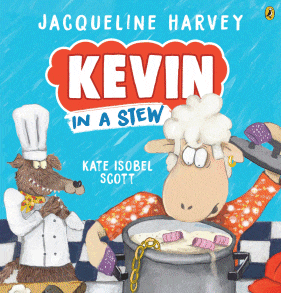
Kevin in a Stew

Kevin in a Stew

Kevin in a Stew


Kevin in a Stew

Jacqueline Harvey

Kate Isobel Scott

Puffin, 2025

32pp., hbk., RRP $A19.99

9781761048975

Shaun, Shauna, Sheryl and Shane are sheep – and are as predictable in their sheepish behaviour as the alliteration of their names.  Along with the rest of the flock, they are happy doing the same things over and over, day after day in their fields of green grass and clover.

But Kevin is different.  To start with, he’s allergic to grass and would much prefer a bowl of soup (sprinkled with chives) and then, instead of subjecting himself to the regular shearing, he prefers to keep his locks long, and have painted purple hooves! 

So no one is really surprised when he decides to make his childhood dream of having his own vegetarian restaurant come true.  His friends are all willing to help out but who will be the chef?  Surely not Wolf who is not known for preferring vegetables over meat, particularly lamb, even though he is adamant that he has changed his ways! But he IS the only applicant!

This is the third in this adorable series by the very talented Jacqueline Harvey and the equally talented Kate Isobel Scott who interprets Harvey’s words into the most appealing pictures that add so much more.  Because they know that young readers respond to rhyme, rhythm and repetition, many authors decide to tell their stories in rhyming text but few manage to achieve the standard that Harvey does.  While others often seem to have to manipulate both vocabulary and syntax to achieve the rhyme, making it all seem rather contrived, Harvey gets a flow that is so natural you can’t imagine the story not being in rhyme, and where it might get a bit tricky, Scott’s illustrations fill in the gaps so both words and pictures form an integrated whole that not only delights the reader but allows them to tell themselves the story as they continue to develop those essential early reading behaviours. 

They will gasp at the drama of the climax as Shaun, Shauna, Sheryl and Shane fail to appear on time on opening night – could they really be bubbling in Wolf’s pot on the stove? Where might they be? What might have happened to them?  And after they breathe a sigh of relief when the mystery is explained, what do they think of the ending?  Can they suggest other recipes that Wolf could put on the menu apart from the one he is considering?

There are frequent reports that literacy standards in Australia are dropping, that we are reading less, particularly young men. and that “something needs to be done about it”.  

Australian Bureau of Statistics. (2024, April 16). How Australian generations spent their time on recreation and leisure. ABS. https://www.abs.gov.au/articles/how-australian-generations-spent-their-time-recreation-and-leisure.

Australian Bureau of Statistics. (2024, April 16). How Australian generations spent their time on recreation and leisure. ABS. https://www.abs.gov.au/articles/how-australian-generations-spent-their-time-recreation-and-leisure.

IMO, apart from developing the mechanics of reading, we as parents, teachers, teacher librarians and significant adults in their young lives need to demonstrate that reading is not only a valid, valuable and valued way to spend our time but it is also fun.  Authors like Jacqueline Harvey (who seems to be able to write effortlessly for all ages) who create such delightful stories and series like this are certainly doing their part by helping capture them from an early age.  Can’t wait to share this (and leave it) with the preschoolers I read to on Fridays!