Archives

I Love to Draw

I Love to Draw

I Love to Draw


I Love to Draw

Dale Baker

Little Big Sky, 2026

32pp., hbk., RRP $A32.99

9781923514263

I am a drawer, and everyone knows –
with just a few shapes, see how magic grows!

Letters and numbers aren’t just what they seem –
they turn into pictures, like out of a dream!

Your imagination will sparkle, your pages will glow –
so come join the fun, let your wild ideas flow!

This is a charming, rhyming book for little people that not only celebrates our imagination and where it can take us, but it also invites the reader to actively explore it – first by turning the book itself to discover what a swan, seal and penguin might become but then by having them pick up their own pencil and starting to create a person…

Draw a big H and a curvy U too, and you’ll be amazed at what you can do.

My experience is that while little people believe almost instinctively that they will be able to read and write one day and are willing to persevere until they do, , they tend to baulk at drawing.  They’re happy to express themselves with paints and crayons and move through a series of developmental stages  but there comes a time when a barrier goes up and they tell themselves that because their efforts don’t look like the real thing, then they are not good enough and so they abandon their attempts. Even though they are exposed to different interpretations of the world around them every time they pick up a picture book as illustrators express themselves in their own unique way, the perception of things having to resemble reality persists – perhaps even compounded by educators requiring them to write first then draw, when, at the very least, they should have a choice.  I wonder whether Baker himself drew his pictures and then crafted the catchy rhyme to fit, or vice versa.  Chicken or egg?

But whichever it was for him, he has created an affirmation that each little person (and not-so) can draw and that marks on paper can take us to magical places and lead to marvellous adventures…

A peek inside....

A peek inside….


The Flower Garden – A Changi Secret

The Flower Garden - A Changi Secret

The Flower Garden – A Changi Secret


The Flower Garden – A Changi Secret

Claire Saxby

Lucia Masciullo

Walker Books, 2026

32pp., hbk.,  RRP $A25.99

9781760657352

I have a secret – we have a secret –
in this place where secrets are not allowed.

Imagine you’re a child with all the natural curiosity, imagination, energy and exuberance that goes with childhood.  But instead of being able to wander and explore the world around you, that world is bounded by high walls and barbed wire, patrolled and guarded by brutal soldiers who do not hesitate to impose their power – even on little children.  Such was the life of many children and their mothers who were long-time residents of Malaya and Singapore but who, with the fall of both countries to the Japanese in February 1942, were herded like animals into the notorious Changi Prison, and treated as such. Days were spent tending the gardens to grow food for their captors in the morning and then on rows of hard benches learning “numbers, words and formulas” and secret songs under the watchful eyes and ears of gun-carrying soldiers in the afternoons. Not until dusk fell was their time their own.

But in that time, the women tried to make life a little more normal for the children, and one in particular, Mrs Elizabeth Ennis, an army nursing sister, began a secret Girl Guides group and taught them how to take their minds, if not their bodies, far beyond the prison walls.  So as her birthday approaches, it is time to make a special present, and in this sensitive, softly illustrated story, Saxby and Masciullo not only divulge what that gift will be but expose the lives of those who made it and the risks they took to do so.

The horrors of Changi have been on my radar since my own childhood because even though my dad was a POW in Germany and eventually force-marched across Poland as part of the Germans’ human shield, even in those days long before television, let alone the internet, the atrocities and barbarities of Changi were known, and the brutality of the captors was being revealed by those like my future father-in-law who miraculously survived the men’s camp, as well as in stories like Nevil Shute’s A Town Like Alice, and movies like The Bridge on the River Kwai (where my f-i-l ended up).  Yet from the depths of the darkest despair, the human spirit soared and stories like the making of this precious gift have emerged.

As I read this book, including the author’s note that offers a short background history of the time, I wanted to know more and a simple search brought many links including stories of those who helped make it, a history of the quilt itself, including close-up photos of it in the Imperial War Museum, as well as information about the other quilts that were made, including the Australian quilt. 


girl guide quilt, Changi, Far East Civilian Internee

girl guide quilt, Changi, Far East Civilian Internee Image: © IWM (EPH 9206)

However, this is not primarily a book for an older, quilt-loving  adult like me but one for younger readers – those, who, had they lived in another time and place, might have been in it – and so, once again, using her gift to use words to put real life into the realm of young readers, Saxby has opened up a whole new world that exemplifies the courage, determination and kindness of humanity even when confronted with its worst aspects, and Masciullo’s illustrations whose tiny details like the child finding wonder in the garden regardless of the overbearing soldier who dominates the image depict resilience and hope and the eternal love of adults determined to protect their children.

Some might question whether this is a topic that its intended audience need know about or, if indeed, it is one they can cope with, but whoever wrote the teachers’ notes is to be congratulated on their thoughtful approach that explores both the story and the history in a way that builds and supports the child’s historical knowledge, social awareness and emotional intelligence, even encouraging the class to create its own quilt. Probing questions that encourage them to think more deeply, understand the lives of others (which some in the class may have experienced in a different context), and focus on those human traits of hope, kindness, courage and empathy underpin an outstanding investigation inspired by the book but which have the potential to be so much broader and longer-lasting.

Among all the books I have read and reviewed over time, this is a stand-out and a must-have in any collection of those who want to better understand how a “simple” story can reveal so much more than the words on the page. 


Storm

Storm

Storm


Storm

Claire Saxby

Jess Racklyeft

A & U Children, 2026

28pp., hbk., RRP $A24.99

9781761181719

The summer beach looks much like it always does when the people have all gone home – empty, peaceful, quiet, ripples lapping on the sand in their endless rhythm…  But above and below the glassy surface,  the creatures are watching and waiting…

It begins with a puff, then another and a shiver dances across the water. A puffball cloud appears, joined by friends, slowly turning from innocent white to menacing grey. – and the watching, waiting creatures take shelter.  Because they know  and they are not wrong.  Soon all hell breaks loose and that quiet, peaceful beach is no more – lashed by a violent summer storm that is so magnificently captured in a four-page gatefold spread as updrafts and downdrafts compete, lightning flashes, thunder cracks and rain lashes the land carried on a wind that seems to know only anger…. 

And then, as swiftly as it came, it has moved on and the land, the sea and their creatures are calm again, emerging to carry on as they were.  But always watching, waiting…

Many of our young readers will have seen a summer storm build and grow and deliver over the last few weeks as “storm season” has lived up to its name, particularly on Australia’s east coast.  And they may well have been frightened at its noise and ferocity as it unleashed its fury on the land below because they know it is more than the angels’ fireworks or a giant’s tummy rumbling as we were told as kids, or even the work of the Greek god Zeus who controls thunder, lightning and rain; his Roman counterpart Jupiter, or even Thor, the mighty Norse god .  

We know knowledge is power and so, in this new release from this team that gave us Volcano, Tree, and Icebergyoung readers learn about storms through both science and art, demystifying this natural phenomenon that can be so scary, particularly if they have seen its impact and aftermath, because although the ocean creatures resume their regular rituals, often it is not so simple for humans, Using her trademark way with words that turn factual statements into poetry, combined with Racklyeft’s gift to create dramatic illustrations that echo the real thing, both have offered the young reader something special that will not only help them understand the storm but also pose questions about how the creatures know something is brewing and the need to prepare, perhaps sending them to find out more. And if not the angels, a giant or Zeus and co., then who and why? And beyond the science, they can let their imaginations roam in language, art, music and movement…

My mum told me I was born on the wings of a storm that was born in the Southern Ocean and swept across southern New Zealand in an angry demonstration of power and might, and perhaps that is why I have watched in awe at so many and they feed my soul.  So to indulge in the lyricism of Saxby’s words and immerse myself in the colours and the energy of Racklyeft’s illustrations is heaven-on-a-stick for me – as I watch yet another one build on the horizon.  ‘Twill be another wild afternoon as Mother Nature shows who is really in charge, methinks. Already the birds are silent…

I Love Me & My Country

I Love Me

I Love Me


I Love Me

Sally Morgan & Ambelin Kwaymullina

Fremantle Press, 2026

12pp., board book, RRP $A17.99

 9781760996659

I love my eyes, I love my nose

I love the way my curly hair grows…

Through rhyming text that bounces along just like a young child and vibrant illustrations that portray the love, this is a joyous affirmation of self from a young child who could be any child, so universal is the message.

Whether it’s Thump, thump, thump, I love the way my legs jump or If I was tall as a tree with worms for hair, and clouds for arms and grass for feet, I’d still love me,  the little people in this book celebrate who they are and what they can do in that unique, unself-conscious way that little ones do as they move and make noise just because they can.  And being a small board book the perfect size for little hands, it is one that the youngest reader will return to again and again for themselves as they mimic the actions of the characters and then make up their own, because there is no one else just like them.  I love the way my heart knows best, I am me.  Who else would I be?

A little book with huge potential for exploring the unique you, the fun of words and the power of print that endures long after the screenshot has moved on.

My Country

My Country


My Country

Ezekiel Kwaymullina & Sally Morgan

Fremantle Press, 2026

32pp., hbk., RRP $A19.99

 9781760996260

In my country I play with the morning star, sing the earth’s song, fly with red desert dust, ride the whispering wind…

Once again, Ezekiel Kwaymullina  and his mother Sally Morgan use their gifts for selecting words and interpreting them in pictures, and then putting them together in a way that reaches the soul and demands we take time to breathe, relax and reflect on the world around us and our connection to it.

A peek inside...

A peek inside…

In an ode to not just noticing but knowing your place, this is a celebration of First Nations’ connection to Country that has to inspire non-Indigenous children to start connecting with the natural elements that surround them.  Who hasn’t shrieked for joy while being buffeted by the wind? Or been in awe of the beauty of a rainbow?  Or watched in fascination from the safety of indoors as lightning flashes and thunder cracks? Even though we might not be able to portray Nature’s wonders in such lyrical, eye-catching ways as the creators of this book for little people, nevertheless this could be the inspiration and impetus to try.  At the very least it should spark a greater awareness of the unique, ever-changing entertainment that Mother Nature is providing and being at one with it and in it. 

Ezekiel Kwaymullina says, ‘The book was inspired by my Nana and Gran, who passed on their love of country to me.’  What if we, as the adults in our children’s lives, could also pass on this gift so that they see their environment as a diverse, ever-evolving playground that offers so much in itself as they journey through the day?  If they too felt cocooned in the cloud blanket that has at last brought moisture to a cracked, desiccated landscape or could be entranced by the raindrop slowly gathering the courage to drop off the leaf and fall to the hard ground below?

With many little ones hearing an Acknowledgement of Country daily in their preschools and big schools but not really understanding that special connection that First Nations peoples celebrate, this is the ideal start to help them understand it better. and perhaps start to build something special in them too. 

Two brilliant books that will open eyes and hearts in a unique way that will endure long after the final page is read. 


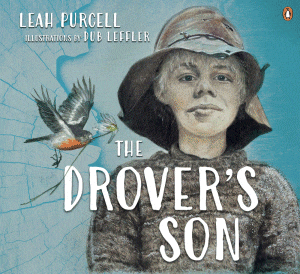
The Drover’s Son

The Drover's Son

The Drover’s Son


The Drover’s Son

Leah Purcell

Dub Leffner

Puffin, 2026

40pp., hbk., RRP $A29.99

9781761341977

In 1892, renowned Australian storyteller Henry Lawson published his short story, The Drover’s Wife in which, through the life of Molly Johnson, he shone a spotlight on the courage and resilience of the pioneer women who followed their husbands to the rural and remote regions of Australia – in this case, the alpine country of New South Wales – and held the fort against the landscape, the isolation, and the dangers of the country while their husbands were away for months at a time trying to earn a living.   

The original story has inspired artworks, retellings, and other interpretations including a play written by Leah Purcell, itself becoming a film, a book and an opera.   Central to Molly Johnson’s story are her love for and protection of her children, and now, emerging from such auspicious beginnings, is this new picture book that focuses on her oldest son Danny, who believes he will have no choice but to leave home and go droving with his father. But then he meets Yadaka, an indigenous man, who despite the attitudes towards First Nations people at the time, takes Danny under his wing and shows him there can be  another path – one in which a man can be wise and gentle, and a warrior too. “It’s not what you wear on your feet, Danny. How you carry yourself is what makes a decent man.”

Set in 1893, with the Ngarigo landscape and intriguing characters perfectly portrayed in Leffler’s exquisite illustrations, Purcell, herself, says, “This is a yarn about fathers and sons, a mother’s love, fierce and true, and about family in whatever form that takes. A tale of cautious meetings, bonding and the sharing of stories.  Of lessons learnt and of cultural understanding and genuine respect. This is a story about a time in our history we shouldn’t forget.”

Although the primary story is Danny’s, Molly’s also remains central as she awaits the birth of yet another child, isolated and without modern medical assistance – giving today’s girls plenty of food for thought. How would they cope with being almost constantly pregnant, the likelihood of losing the baby anyway, while all the while having to take full responsibility for the other children 24/7?

Whether it is read and shared through the lens of the power and endurance of the women of the time; the attitudes towards and treatment of First Nations peoples; Yadaka’s connection to Country and heritage and the importance of that; the difference in childhood between then and now; the relationship between Yadaka and Danny and the importance of role models; the visual literacy of Leffler’s interpretation of a landscape and history that I see daily out my window; the reimagining of a story from long ago into so many versions so that it is as powerful today as it was then; or any other perspective this is a must-have addition to the collection that will open up so much of this nation’s early European history for older, independent readers.  

The Little Cloud

The Little Cloud

The Little Cloud


The Little Cloud

Pam Fong

Greenwillow, 2025

40pp., hbk., RRP $A29.99

9780063359994

The dark before dawn and the clouds have gathered for they have important work to do because each knows that a cloud’s job is to make storms -it’s fun and they love it, so each is busy being busy gathering what they need to create havoc. 

All except one, that is. Little Cloud would much rather slop away to take a moment to enjoy the view of the world below. As light spread overs the land Little Cloud sees the farmer is whistling, the piglets are having a snack, the bees are buzzing, the ducks are waddling, the  stream is babbling and the cows are enjoying the fresh, green grass.  One even winks at him!

But Big Grey Cloud is angry with Little Cloud and no are the others – there’s no time for that sort of nonsense.  There are storms to create..  Until…

It seems like Little Cloud’s life echoes that of many of our children today, as the adults around them always seem to be in a rush and there is no time just to be. As though taking a moment to admire what is around us is not only unworthy and wasting time but something to actually condemn.  But what is actually happening while they are so busy with work, work work and everything else that fills the time? Can the readers spot the looming danger?

This is a clever book that encourages little ones to stay curious, be observant and see the little things that make up life and the clever formatting that ensures they engage with the illustrations support this.  But, at the same time, they could suggest the sort of music and movement that might represent the storm clouds and Little Cloud, contrasting the two and maybe even using their bodies to make it.  It could even spark an investigation into what clouds are, how storms are formed and the weather generally. 

This is a wonderful example of visual storytelling where young readers can involve all their senses as they suggests words that describe what they are seeing, what they might be hearing, how Big Cloud and Little Cloud are feeling, as well as predicting what the two blank pages portray. 

Masterful.

A peek inside...

A peek inside…

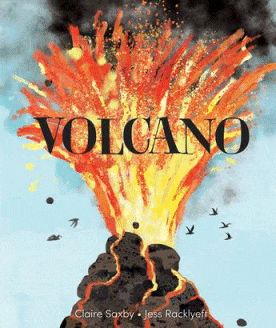
Volcano

Volcano

Volcano


Volcano

Claire Saxby

Jess Racklyeft

A & U Children’s, 2025

28pp., hbk.,  RRP $A24.99

9781761180644

In The Boundless Deep the first part of his classic novel, Hawaii,  James A. Michener crafts the most picturesque, detailed description of the formation of the island as far below the ocean the Earth’s surface ruptures and its innards spew out.  It is a masterpiece of writing, one that has stayed with me since I first read it in 1969 during Port Moresby’s seemingly endless wet season – and I still have that original copy!

Now, in language just as arresting but much simpler and thus accessible to our younger readers, and accompanied by the stunning illustrations of Jess Racklyeft, master narrator Claire Saxby brings a similar event to life in her new release, Volcano.

Deep in the ocean, far beyond the reach of even the brightest sun, the earth quakes.

Hagfish scatter and snailfish flutter.

Lava pillows flash and fade, rumpling the seabed as a new volcano births a mountain…

Through words and pictures – that include incredible double double-page spreads – the young reader can witness the invisible until it not only becomes visible, but inhabited as new life begins, underscoring the interdependence and symbiosis of land, sea and sky and the wonder that is so much more than startling, eye-catching pictures on a television newsclip.

When it comes to capturing children’s imaginations and curiosity, creating a volcano is one of the go-to experiments that always evokes wonder, and this book with its dramatic cover is sure to attract attention.  But it is the continuation of the story after the initial eruption, the explanation of chemosynthesis, where chemicals create food energy, far beyond the reach of light in ecosystems around hydrothermal vents, and how tiny bacteria and other minute creatures form to drift away as the chimneys grow and cool and both carry and become food for others that sets this apart.

Like that first rumble under the seabed, this book grows and grows, providing the ideal platform and introduction to the earth sciences for the curious mind.  It is an ideal addition to that collection that explores and explains the formation of the planet and the life which inhabits it that includes

Our Country: Ancient Wonders

BANG! The Story of How Life on Earth Began

Australian Backyard Naturalist 

Earth is Big

We are One: How the World Adds Up

Australian Backyard Explorer

The History of Everywhere

The Amazing Meals of Martha Maloney

A Hundred Thousand Welcomes

Atlas of Amazing Migrations

Ouch! Tales of Gravity

The Same But Different

Evolution

On the Origin of the Species

Who Makes an Ocean?

How We Came to Be: Surprising Sea Creatures

Green: The Story of Plant Life on our Planet

Cosmic Wonder

How We Came to Be; Creatures of Camouflage and Mimicry


About 300 miles off the coast of Oregon, an underwater volcano appears to be rumbling to life. Scientists who have been monitoring the vast submarine volcano for decades say a flurry of recent activity — including an uptick in earthquakes in the vicinity, and swelling of the structure itself — signals that it’s ready to erupt. Current forecasts project that the volcano, known as Axial Seamount, could erupt anytime between now and the end of the year, according to Bill Chadwick, a volcanologist and research professor at Oregon State University.

About 300 miles off the coast of Oregon, an underwater volcano appears to be rumbling to life. Scientists who have been monitoring the vast submarine volcano for decades say a flurry of recent activity — including an uptick in earthquakes in the vicinity, and swelling of the structure itself — signals that it’s ready to erupt. Current forecasts project that the volcano, known as Axial Seamount, could erupt anytime between now and the end of the year, according to Bill Chadwick, a volcanologist and research professor at Oregon State University. Click here to watch a video of the possibilities.  Videos, including livestream, of the volcano, are available from Ocean Observatories


Listen to Claire Saxby talk about the book on the ABC Science Show.

Livestream the latest eruption of Hawaii’s Kilauea volcano


Bush Bubs

Bush Bubs

Bush Bubs


Bush Bubs

Helen Milroy

Fremantle Press, 2025

32pp., hbk., RRP $A19.99

9781760994471

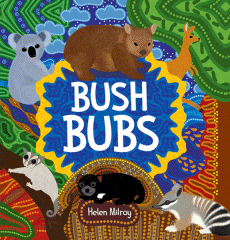
Baby anythings fascinate young readers and this new addition to this series which focuses on some of the iconic babies of the bush will delight them, not just because of the bright, eye-catching illustrations but also the additions to their vocabulary.  While they probably know that a baby kangaroo is called a joey, do they know whose baby is a puggle?  And if a dingo baby is a pup, what is a baby wombat?

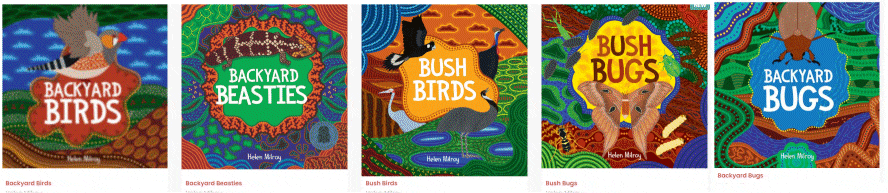
Once again, as with Bush Bugs, what seems like a book for a baby with brief, rhyming text and colourful pictures becomes the conduit for a lot of learning far beyond the page, with teachers’ notes offering even further suggestions for art, movement, science and environmental awareness.  Why does Milroy implore us to look after these “precious bush bubs”? 

A descendant of the Palyku people of the Pilbara region of Western Australia. Milroy has a distinctive illustrative style that is probably quite different to the pictures that the young reader is familiar with, particularly with the pattern and detail being in the background rather than the focal point, and so this series could also be a starting point to exploring this technique, perhaps even emulating it in their own artwork.  

Such a rich series to invite little ones to start thinking about and exploring the world around them.

The series so far...

The series so far…